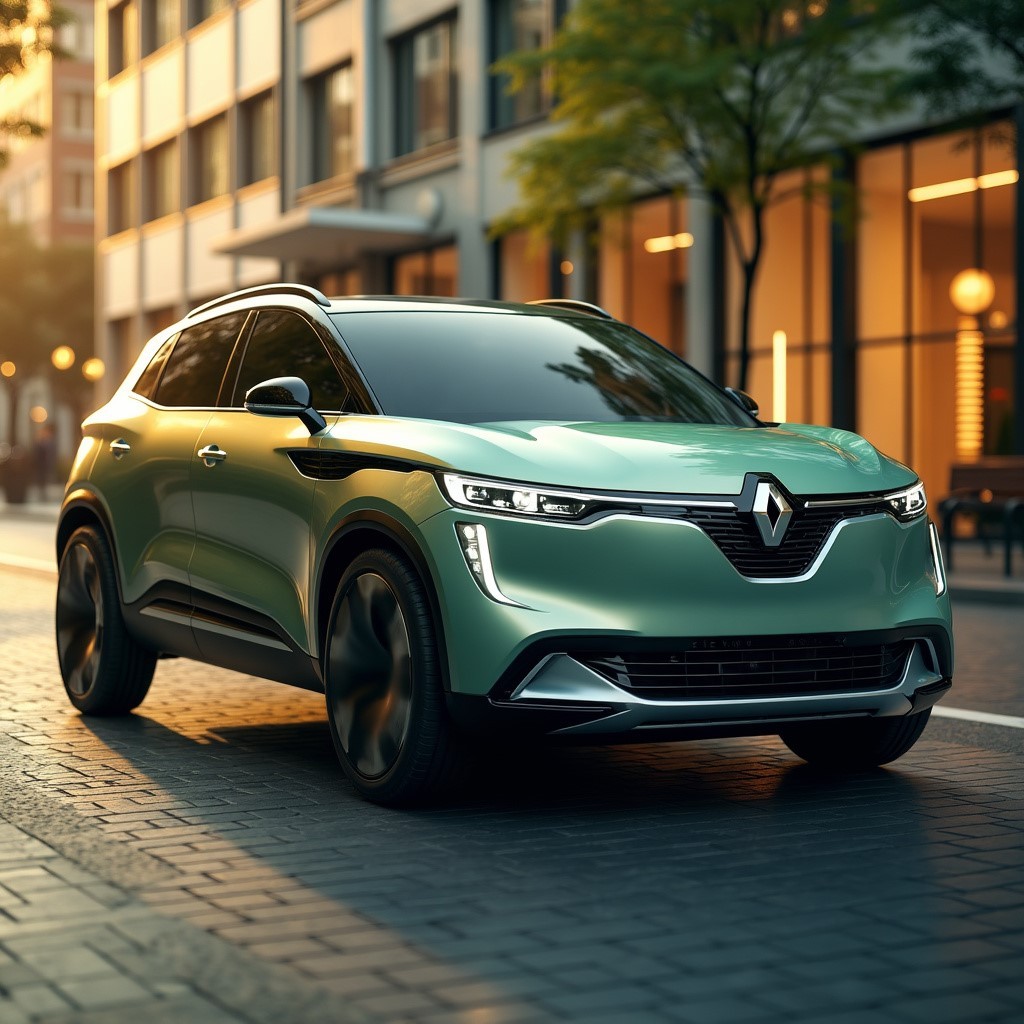

The Renault Symbioz is Renault's family-sized hybrid SUV. It sits between the Captur and the Austral. For 2026 it gets a bigger 1.8-litre E-Tech 160 full hybrid, plus a cheaper mild hybrid 140 with a manual gearbox. This guide covers UK specs, trims, list prices, company car tax and how leasing a Symbioz through First Vehicle Leasing works.
Key Takeaways
- You can choose from two powertrains for 2026: the mild hybrid 140 (1.3-litre turbo, six-speed manual, 47.9mpg WLTP, 134g/km) and the full hybrid E-Tech 160 (1.8-litre, 1.4kWh battery, up to 65.7mpg WLTP, 97g/km).
- Renault UK list prices start at £27,595 for the mild hybrid Techno and go up to around £33,995 for the Iconic Esprit Alpine full hybrid (September 2026).
- The boot holds 492 litres, or 624 litres with the sliding rear bench pushed forward.
- Company car tax (Benefit in Kind) for 2026/27 is 25% for the full hybrid and 32% for the mild hybrid.
- Euro NCAP gave the Symbioz four stars out of five in 2024.


What Is the Renault Symbioz?
The Renault Symbioz is a 4.4-metre family SUV. It uses the same CMF-B platform as the Clio and Captur and sits between the Captur and Austral in Renault's range. It's only sold with hybrid petrol engines, and it goes after the Nissan Qashqai on price rather than on size.
The name comes from the Ancient Greek word symbiosis, meaning 'living together'. The roof is kept to around 1.6 metres to help aerodynamics, so it looks more like an estate than a tall SUV. The original 145hp E-Tech hybrid launched in 2024 with a 1.6-litre engine and a 1.2kWh battery, and it has now been replaced. If a review quotes 145hp, it's describing the old car.
Which Engines Does the 2026 Renault Symbioz Have?
The 2026 Symbioz has two front-wheel-drive powertrains. The mild hybrid 140 pairs a 1.3-litre turbo petrol with a six-speed manual. The full hybrid E-Tech 160 combines a 1.8-litre petrol engine, two electric motors and a 1.4kWh battery with an automatic gearbox. Neither needs plugging in.
| Spec (WLTP where stated) | Mild hybrid 140 | Full hybrid E-Tech 160 |
|---|---|---|
| Engine | 1.3-litre turbo, four-cylinder | 1.8-litre, four-cylinder plus two electric motors |
| Power | 140hp, 240Nm | 160hp |
| Gearbox | Six-speed manual | Multi-mode automatic |
| 0-62mph | 11.1 seconds | 9.1 seconds |
| Fuel economy | 47.9mpg | Up to 65.7mpg |
| CO2 | 134g/km | 97g/km |
| Maximum towing | 1,200kg | 1,000kg |
| Trims | Techno, Techno Esprit Alpine | Techno, Techno Esprit Alpine, Iconic Esprit Alpine |
The full hybrid is a self-charging hybrid. It recharges its small battery as you drive and can run on electricity at town speeds. Renault quotes a total range of up to 675 miles. The E-Save button holds battery charge back for harder driving, such as motorways or steep climbs. It is not a way to extend electric-only running. The updated gearbox also adds a motorway mode that's meant to cut noise.
How Much Does the Renault Symbioz Cost in 2026?
Renault UK lists the Symbioz from £27,595 for the mild hybrid Techno, rising to around £33,995 for the Iconic Esprit Alpine full hybrid (September 2026). At launch the full hybrid started at £29,795 and the Techno Esprit Alpine mild hybrid at £29,595. Every version is under £40,000.
| Trim | Engines | Key equipment |
|---|---|---|
| Techno | Mild or full hybrid | 18-inch alloys, 10.4-inch OpenR Link touchscreen with Google built-in, 10.25-inch driver display, adaptive cruise control, reversing camera, wireless charging, keyless entry |
| Techno Esprit Alpine | Mild or full hybrid | Adds 19-inch alloys, sportier trim, heated front seats, powered tailgate, electric driver's seat, extra driver aids |
| Iconic Esprit Alpine | Full hybrid only | Adds Solarbay panoramic roof (switches between clear and opaque), Harman Kardon audio, 360-degree camera, hands-free parking |
Staying under £40,000 matters. According to GOV.UK's vehicle tax rate tables, petrol and hybrid cars listed above £40,000 pay an extra £440 a year expensive car supplement from year two. No Symbioz pays it. The standard rate of Vehicle Excise Duty (VED), administered by the DVLA, is £200 a year for 2026/27. First-year rates are £365 for the full hybrid and £560 for the mild hybrid. On contract hire, road tax is normally included in your rentals.
How Practical Is the Renault Symbioz?
The Symbioz's boot holds 492 litres. Slide the rear bench forward by up to 16cm and it grows to 624 litres. That's a lot for a car this length and close to the Nissan Qashqai's 504 litres. It also has far more room than the Captur, which it's based on.
The sliding bench lets you trade legroom for luggage space depending on the trip. Adults fit comfortably in the outer rear seats, but three across the back is a squeeze. The mild hybrid can tow up to 1,200kg and the full hybrid 1,000kg, which is enough for a small caravan or trailer.
What Safety and Technology Does the Symbioz Have?
Euro NCAP gave the Symbioz four stars out of five in 2024, the same score as the Captur. That's a step down from Renault's older five-star results, although the car is well equipped. Renault now quotes up to 30 driver assistance systems, and you can set your preferred ones with a single button.
Every trim gets Google Maps, Google Assistant and more than 50 apps through the 10.4-inch screen. Wireless Apple CarPlay and Android Auto are included. The My Safety Switch lets you choose which driver aids, such as lane keeping, are active and save that setup. It's a small feature, but a useful one if the default warnings annoy you.
Will I be approved?
Five questions, no sign-up, and an honest answer before you apply for anything.
Check my eligibilityWhat Is the Renault Symbioz Like to Drive?
The Symbioz is relaxed and economical at a steady pace, and it often runs on electric power around town. Push it hard and the full hybrid gets noisy. Ride comfort can feel firm at low speeds. It's a car for sensible family driving rather than keen drivers.
Real-world economy is good. During Fleet News' six-month long-term test of the older E-Tech 145, the car returned more than 53mpg on every tank against a 61.4mpg WLTP figure. The tester's one complaint was the gearbox occasionally dropping a gear and revving for no obvious reason. Renault says the E-Tech 160 shifts more smoothly and uses about 5% less fuel. Road testers agree it's quicker, but it's still loud under heavy throttle.
How Does Leasing a Renault Symbioz Work?
With Personal Contract Hire (PCH) or Business Contract Hire (BCH), you rent a new Symbioz for a fixed term, usually two to four years. You pay an initial rental and then fixed monthly rentals, and you hand the car back at the end. You never own it, so you don't have to sell it or worry about what it's worth.
The initial rental is normally one, three, six or nine months' worth of rental, paid at the start. It is not a deposit and you don't get it back. Your rentals cover the gap between the car's cost and its forecast residual value (what it's expected to be worth when your lease ends), plus interest charges. We buy in volume, which brings the starting cost down while the forecast end value stays the same. If the car is worth less than forecast when you hand it back, the funder takes that loss, not you.
First Vehicle Leasing has been arranging leases for over 25 years. We're authorised and regulated by the FCA as a credit broker and are a BVRLA member. When you return the car, its condition is judged against the BVRLA's industry fair wear and tear standard.
What Will a Symbioz Cost as a Company Car in 2026/27?
For the 2026/27 tax year, the full hybrid E-Tech 160 (97g/km) falls in the 25% Benefit in Kind (BIK) band, and the mild hybrid 140 (134g/km) in the 32% band. That's a gap of seven percentage points. For most company car drivers, it makes the full hybrid the clear choice.
Under HMRC's appropriate percentage tables, cars emitting 75g/km or more start at 21%. They add one percentage point for every 5g/km above 75g/km, with CO2 rounded down to the nearest 5g/km, up to a 37% cap. Across petrol and diesel cars in general, BIK runs from roughly 15% to 37% of list price. HMRC has also confirmed that these bands rise by one point in each of 2028/29 and 2029/30, so check this if your lease runs past April 2028.
Illustrative example: a Symbioz with a £30,000 P11D value (list price including options and VAT) at 25% creates a £7,500 taxable benefit. A basic-rate (20%) taxpayer pays £1,500 a year, and a higher-rate (40%) taxpayer pays £3,000. At 32%, the same £30,000 car creates a £9,600 benefit, which costs a 20% taxpayer £1,920 a year.
If you lease through a VAT-registered business, HMRC normally lets you reclaim 50% of the VAT on rentals where the car is available for private use. Both Symbioz versions emit over 50g/km, so 15% of the rental can't be deducted for corporation tax. If BIK is your main concern, an electric car through salary sacrifice sits at just 4% for 2026/27.
Which Symbioz Should You Lease?
For most drivers, our leasing experts recommend the full hybrid E-Tech 160 in Techno trim. It has the lowest fuel use and BIK, and all the equipment most people need. The mild hybrid only really makes sense if you want the cheapest list price and are happy with a manual.
- Mostly town and suburban driving, or a company car driver: full hybrid Techno.
- Want the lowest list price and prefer a manual, mostly on motorways, and paying no BIK: mild hybrid 140 Techno.
- Want heated seats, a powered tailgate and a smarter cabin: Techno Esprit Alpine.
- Want the Solarbay roof and 360-degree camera: Iconic Esprit Alpine.
- All buyers: set your annual mileage from your real driving, not a guess, because excess mileage charges soon add up.
So what else is worth a look?
Most people don't need one particular model. They need the best car for their budget, so it's worth comparing a few before you decide.
Renault Captur
The Renault Captur shares the Symbioz's front end and hybrid technology in a shorter, cheaper package, with a smaller boot.
Renault Austral
The Renault Austral is a size up, with a more upmarket cabin and Renault's more powerful E-Tech hybrid.
Nissan Qashqai
The Nissan Qashqai is the family SUV benchmark, with a 504-litre boot and a strong hybrid option.
Dacia Bigster
The Dacia Bigster is Dacia's largest SUV. It's a value-focused choice with hybrid power available.


Ready to Lease a Renault Symbioz?
Rentals change daily, so check the Symbioz page for today's deals on each trim, term and mileage. To talk through which version suits your driving or your company car policy, call First Vehicle Leasing on 0333 003 3325.
Cars in this article


Related guides
How to Choose the Right Annual Mileage for a Car LeaseServicing & Maintaining a Leased Car: Whose Job Is It?What Does It Cost to Charge an EV? UK Costs ExplainedBEV vs PHEV vs Hybrid: Which One Suits You?View all guidesFrequently Asked Questions
Sources
- Vehicle tax rates: cars registered on or after 1 April 2017 - GOV.UK / DVLA
- Renault Symbioz E-Tech long-term test review - Fleet News
- Work out the appropriate percentage for company car benefits (480: Appendix 2) - HMRC / GOV.UK
Written by Andy Bell, First Vehicle Leasing.