
Leasing a car is a credit product, which means the first hurdle between you and a brand-new vehicle isn't choosing the colour — it's the credit check. The good news is that with a bit of preparation, most UK drivers can put themselves in a strong position before they ever submit an application. At First Vehicle Leasing, we process credit applications every day and see exactly what funders look for. This is our straightforward 2026 guide to credit checks, what to do before you apply, and how to give yourself the best chance of approval at the best monthly rate.
Key Takeaways
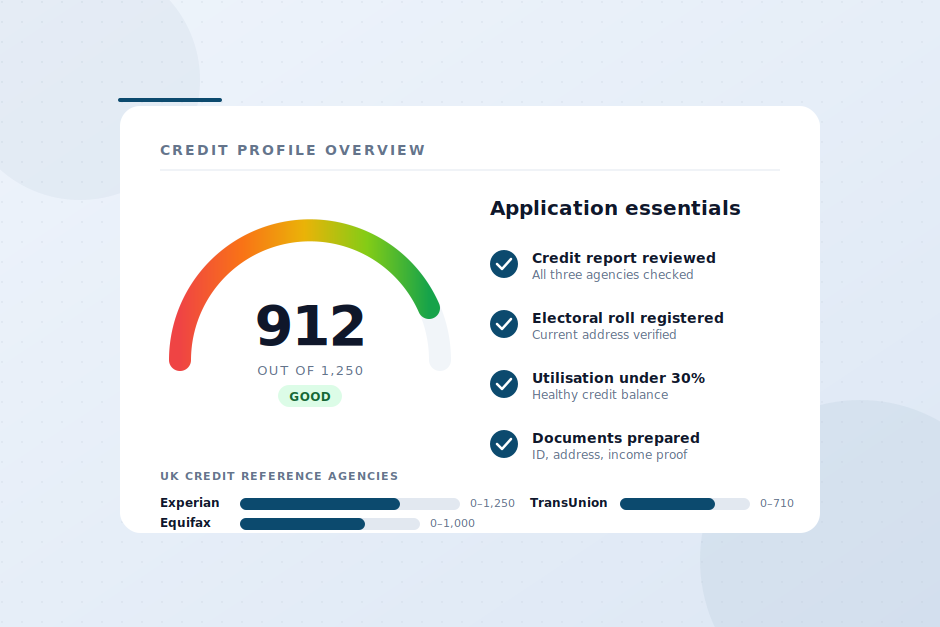
- UK lenders use three main credit reference agencies: Experian (now scoring 0–1,250 since November 2025), Equifax (0–1,000) and TransUnion (0–710).
- Most funders look for a "good" rating or higher to approve a lease on standard terms, but the score is only one factor — affordability, employment stability and existing commitments matter just as much.
- A soft-search eligibility check leaves no mark on your credit file. A full application triggers a hard search visible to other lenders for up to two years.
- Being on the electoral roll, keeping credit utilisation below 50%, and avoiding multiple applications in quick succession are the three quickest wins before applying.
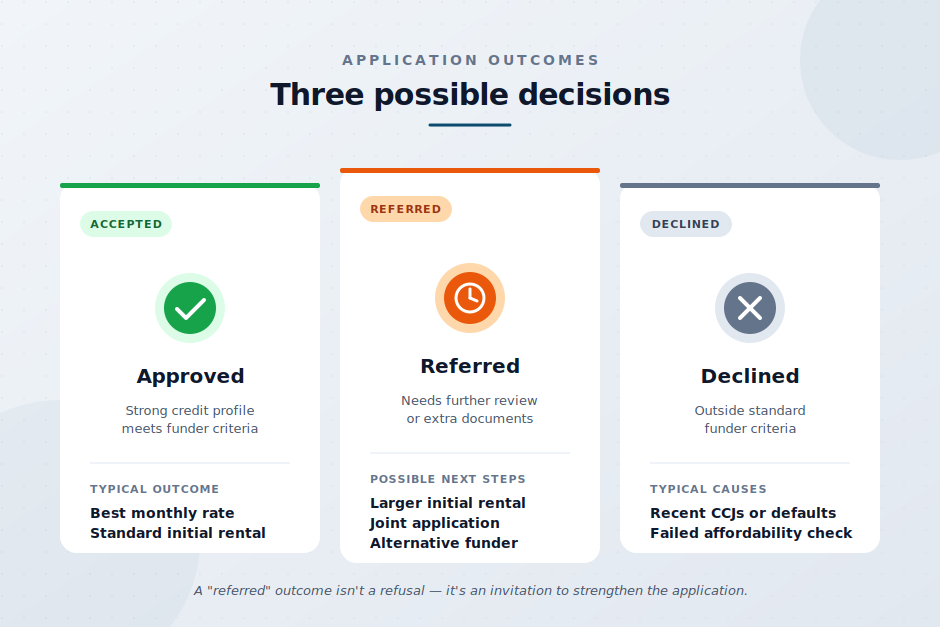
- A larger initial rental, a joint application, or a less expensive vehicle can all unlock approvals on borderline credit profiles.
- If you have recent CCJs, defaults, an IVA or a recent bankruptcy, our bad credit car leasing page sets out the specific options available.
Why Funders Care So Much About Your Credit
Leasing is finance. The funder behind the agreement buys the vehicle and lets you use it for a fixed term in exchange for monthly rentals. They're carrying the cost of that car for the next two, three or four years — so before they hand over the keys, they need confidence that you'll keep paying every month until the contract ends.
Your credit score is the quickest way for a funder to assess that risk. A higher score signals you've managed credit well in the past and are likely to continue doing so. A lower score doesn't automatically mean rejection, but it usually translates into one of three things: a higher monthly rental, a larger initial payment, or a request for additional security such as a guarantor.
The Three UK Credit Reference Agencies in 2026
One of the most confusing things about UK credit scoring is that there isn't a single number. Three different agencies hold credit data on you, and each uses its own scale. The score you see on a free credit-checking app is the agency's own indication of how a typical lender might view you — the lender themselves will run their own internal scorecard on top.
The biggest recent change is on the Experian side. In November 2025, Experian moved from a 0–999 scale to a more granular 0–1,250 scale, and added new data points such as rent payments, mortgage overpayments, and overdraft use. If you're checking your score in an older banking app, you may still see the previous range.
| Credit Reference Agency | Score Range | "Good" Band | "Excellent" Band |
|---|---|---|---|
| Experian | 0–1,250 | 861–1,000 | 1,121–1,250 |
| Equifax | 0–1,000 | 671–810 | 811–1,000 |
| TransUnion | 0–710 | 604–627 | 628–710 |
Bands are guides only. Lenders use their own internal scoring models on top of the CRA data, weighted to their own risk appetite, so a "good" rating with one CRA might still get a different decision from two different funders.
What Funders Assess Beyond the Score
The headline number is just the start. When a leasing application reaches the funder, they're building a fuller picture from several inputs.
Affordability
You could have a near-perfect score and still be declined if the rental looks like a stretch against your income and existing commitments. Funders run an affordability calculation based on income, regular outgoings, and any other credit you're already servicing.
Employment & Residency
Funders prefer consistency: typically three years of UK address history and a stable employment record. Frequent moves or job changes aren't a deal-breaker, but you'll usually need to provide more supporting documentation.
Recent Credit Activity
Multiple credit applications in a short window are a red flag. The same applies to recent missed payments, defaults, County Court Judgements (CCJs) or IVAs — each leaves a footprint that funders can see clearly.
Length of Credit History
This catches out a lot of younger drivers. If you've never held credit before, there isn't enough data on file for a funder to assess you reliably. A small credit card paid off in full each month builds a usable profile within six to twelve months.
Soft Checks vs Hard Checks: Why It Matters
This is one of the most useful things to understand before you start shopping for a lease. There are two types of credit search a funder might run, and they have very different consequences for your file.
Soft Check
- No visible footprint on your file
- Other lenders cannot see it
- Doesn't affect your score at all
- Used for eligibility checkers and pre-approval
- Safe to run as often as you like
Hard Check
- Leaves a footprint visible for up to 2 years
- Other lenders can see each one
- May cause a small temporary score dip
- Triggered by a full application
- Multiple in quick succession is a red flag
The practical takeaway: don't apply for several leases in quick succession to "see what comes back". Use a soft-search eligibility tool first, find the deal you actually want, then submit one full application.
Six Things to Check Before You Apply
A bit of housekeeping in the weeks before you apply can lift your chances meaningfully. Run through this checklist before submitting any application.
- Pull your credit report from all three agencies. Free reports are available from Experian, Equifax and TransUnion. Look for errors, old accounts, financial associations with ex-partners, and any signs of fraud. Disputed corrections take a few weeks to flow through but make a real difference.
- Make sure you're on the electoral roll. The single most overlooked step. Funders use the electoral roll to verify your identity and address — if you're not registered at your current address, the verification check fails and the application is often declined automatically. You can register in five minutes at gov.uk.
- Bring credit utilisation down. If you're using a high percentage of your available credit limits, pay it down before applying. Aim for under 50% across all your cards combined; under 30% is better. This single change can lift your score within one billing cycle.
- Have your documents ready. Most applications require a valid UK driving licence, three years of UK address history, proof of income (recent payslips, or two years of accounts if self-employed), and bank account details. Business leases also need company accounts, business bank statements and director details.
- Use a soft-search eligibility checker. Before committing to a full application, see what a soft search throws up. If the result is borderline, address the issues first rather than triggering a hard search and a possible decline.
- Calculate the real monthly cost. The headline rental is only part of the picture. Factor in the initial rental (typically three, six or nine months upfront), insurance, road tax if not included, maintenance if not bundled, and potential excess mileage charges.
Speak to our team about your options
If Your Credit Profile Is Borderline
If you've checked your file and the picture isn't quite where you'd like it, you have a few practical options that can tip a borderline application into approval.
Larger Initial Rental
Putting more money down upfront reduces the funder's exposure over the contract term and can unlock approvals that would otherwise be borderline.
Joint Application
A joint lease with a partner or family member who has a stronger profile combines both incomes and credit histories on the underwriting decision.
Less Expensive Vehicle
A smaller monthly rental brings the affordability calculation comfortably within reach and is often the simplest way to secure approval.
If your profile includes recent CCJs, defaults, an IVA or a recent bankruptcy, a standard lease application probably isn't the right starting point. We do have a separate route for drivers in this situation — have a look at our bad credit car leasing page, which sets out the options and the funders we work with for non-standard credit profiles.
How Leasing Affects Your Credit Going Forward
Once your lease is approved, the agreement is recorded on your credit file and reported monthly. Every on-time payment is a positive marker that builds your profile over the contract term — which is why a successfully completed lease often leaves your credit position stronger than when you started.
Missed payments work the other way. Each one is recorded, and a default on a lease agreement can knock hundreds of points off your score and result in the loss of the vehicle. The practical advice is simple: set up the direct debit, make sure the funds are there each month, and let the agreement do positive work for you in the background.
Building Your Credit Before You Apply
If you're not in a rush, six months of focused work can change your credit profile materially. None of this is glamorous, but it's the most reliable way to put yourself in a position to get the deal you actually want when you do apply.
- Register to vote at your current address. The fastest single improvement you can make.
- Set up direct debits for every recurring bill. Missed payments on utilities, mobile contracts and credit cards all hurt your score.
- Bring credit card balances down. Aim for under 30% utilisation on each card before each statement date.
- Avoid making fresh credit applications. Each hard search adds a footprint, and clusters of them are a red flag.
- Close unused credit accounts carefully. Sometimes helpful, sometimes not — closing your oldest account can shorten your credit history.
- Check all three agencies for errors. Mistakes are more common than people expect, and the dispute process is straightforward.
- Build a thin credit profile if you have none. A credit-builder card used responsibly for six to twelve months establishes a foundation that funders can actually score.
Frequently Asked Questions
There's no single threshold, because each funder uses their own scoring model on top of the credit reference agency data. As a guide, a "good" rating with any of the three agencies will give you access to most standard lease deals. A "fair" rating may still be approved but often with a larger initial rental or slightly higher monthly figure. The strongest deals tend to go to applicants in the "good" or "excellent" bands.
No. Checking your own score is a soft search, which leaves no footprint and doesn't affect the score itself. You can check it as often as you like. Only hard searches, created when you actually apply for credit, can temporarily lower your score.
Experian rolled out a new scoring model in late 2025, expanding the scale from 0–999 to 0–1,250. Around 44% of users saw their band drop, while 42% saw an increase. The underlying credit data on your file hasn't changed, so the way lenders actually assess you is the same. The new score simply reflects a more granular view of the information already on your report, with new data points such as rent payments and overdraft use now factored in.
No. All UK leasing agreements involve a credit check, because leasing is a regulated credit product. Any company offering "no credit check" leasing is either misrepresenting their process or operating outside standard regulation. A soft search to see if you'll qualify won't affect your score, but a full application will always include a hard search.
Often, yes. A larger initial rental reduces the total amount the funder is exposed to over the contract term, which can tip a borderline application into approval. It also lowers your monthly figure, which improves the affordability calculation. If your credit isn't quite where it needs to be, offering nine months upfront instead of three is one of the simpler levers to pull.
Missed payments stay on your credit file for six years from the date they occurred. Defaults, CCJs, IVAs and bankruptcies are also recorded for six years. Their impact on your score lessens over time, particularly once they're more than two or three years old, but they remain visible to funders running a full credit search throughout that six-year window.
Some funders will accept a guarantor, but it isn't standard practice across the industry and the criteria are strict. The guarantor needs a strong credit profile, sufficient income to cover the rentals if you can't, and willingness to take on legally binding responsibility for the agreement. A joint application with a partner is more common and often easier to arrange.
Sources
- What is a good credit score? — Experian UK
- Experian launches new 0–1,250 credit score — Experian PLC, November 2025
- Understanding your credit score — Equifax UK
- Your credit score — TransUnion UK
- How to improve your credit score — MoneyHelper
- Register to vote — GOV.UK
- Credit and borrowing — Financial Conduct Authority
Disclaimer: This article is for general information only and does not constitute financial or credit advice. Credit decisions are made by funders based on individual circumstances and are subject to status. Score band information is current as of Q1 2026 and reflects published guidance from each credit reference agency. All lease pricing is subject to credit approval and status. First Vehicle Leasing is authorised and regulated by the Financial Conduct Authority.
Author: FVL Expert Leasing Team. With over 25 years of experience in the UK vehicle leasing market, we provide authoritative, FCA-regulated advice on personal and business contract hire.