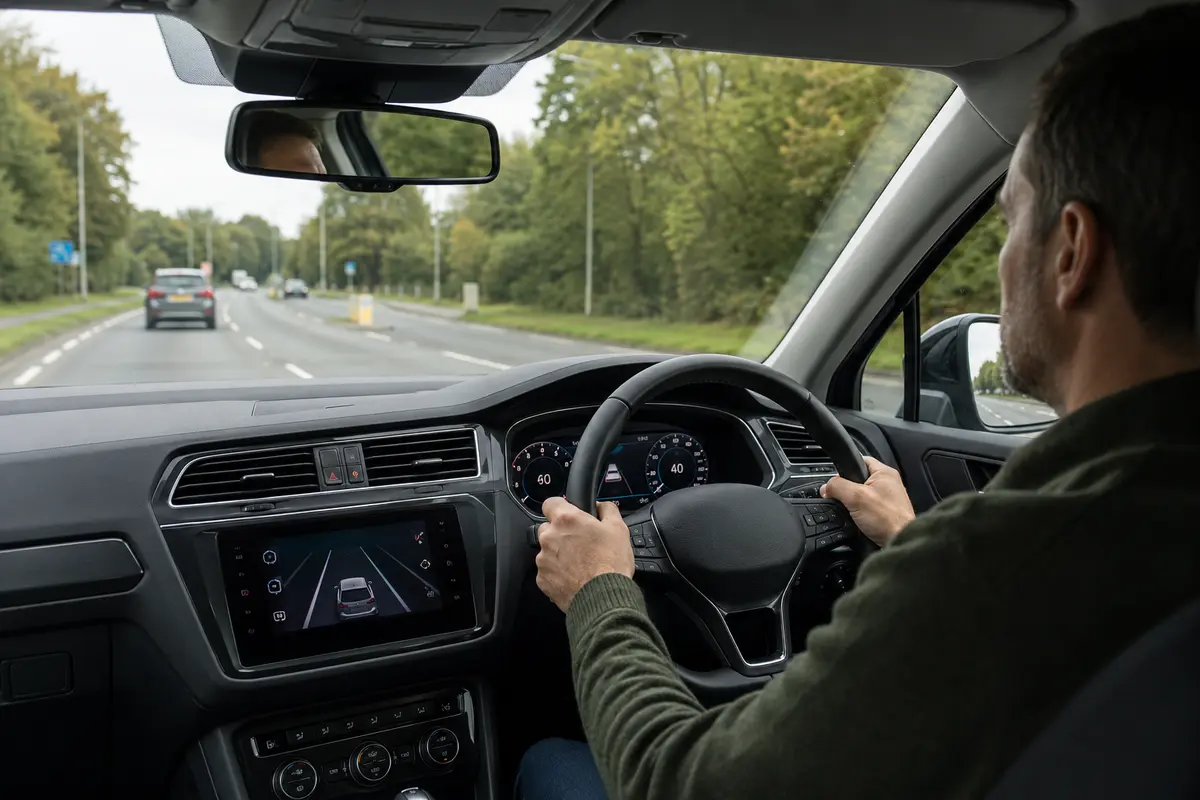

Driver assistance systems are moving from nice-to-have spec-sheet extras into something lease customers will meet more often when comparing new cars. That matters because the systems are not just brochure technology. They can change how a car feels on a commute, on a motorway run, around town, or during a handover when you are trying to understand what all the alerts mean.
The latest hook is the UK government's response to its consultation on mandating vehicle safety technologies in GB type approval. The careful wording is important: the government intends to proceed with a package of vehicle safety technologies for mass-produced vehicles under GB type approval, with implementation dates linked to when the legislation enters into force. That is not the same as saying every lease car has every feature today.
For anyone choosing a personal or business lease car, the practical question is simpler: how do these new car safety features behave in real life, and what should you check before signing up for a model, trim or option pack? Well-integrated safety technology can support the driver and make a car easier to live with. The concern is when a car looks right on paper but its warnings, steering nudges or speed-limit alerts do not suit the roads you use most.
What is changing in GB vehicle safety technology?
GOV.UK says the government will proceed with the package of 18 vehicle safety technologies set out in the consultation, with revised timings to give more time for compliance. The policy is about GB type approval for mass-produced vehicles, not a blanket overnight rule for every car already on the road or every used vehicle available to lease.
The package includes several systems lease customers are likely to recognise, including Intelligent Speed Assist, emergency lane keeping, blind spot information, drowsiness and attention warning, emergency braking for pedestrians, cyclists and vehicles, reversing motion awareness and tyre pressure monitoring. Some are about preventing or reducing collisions. Others are about visibility, warning the driver, crash protection or retaining data after an incident.
For new GB vehicle types, GOV.UK says the requirements for complete and completed vehicles will apply 12 months after the legislation enters into force. For new GB registrations of complete vehicles, most technologies are set at 24 months after entry into force, with later timing for direct vision and event data recorder. Completed vehicles, such as certain multi-stage builds, have longer revised timings.
That timing detail matters for leasing. A customer comparing cars in 2026 may see some systems fitted already because manufacturers share designs across markets, chase Euro NCAP ratings, or build cars for Europe and Northern Ireland as well as Great Britain. Another car, trim or body type may have a different feature mix. So the useful question is not simply "is safety tech mandatory?" It is "which systems are fitted to this specific car, how do they work, and are they right for my driving?"
Policy timing explainer
Use relative timing only until legislation enters into force.
| Band | What it means for GB type approval |
|---|---|
| Entry into force | The legislation begins. Do not translate this into a calendar date until the final legislation is confirmed. |
| EiF + 12 months | New GB vehicle types for complete and completed vehicles: requirements apply for the package of technologies. |
| EiF + 24 months | New GB registrations of complete vehicles: requirements apply for all technologies except direct vision and event data recorder. |
| EiF + 36 months | New GB registrations of complete vehicles: direct vision and event data recorder. New GB registrations of completed vehicles: all technologies except direct vision and event data recorder. |
| EiF + 48 months | New GB registrations of completed vehicles: direct vision and event data recorder. |
Caption: GOV.UK timings are relative to when the legislation enters into force, not fixed publication dates.
Source: GOV.UK government response, updated 16 July 2026.
The systems lease customers are most likely to notice
Some mandated technologies sit quietly in the background. Others make themselves known through sounds, steering assistance, dashboard alerts or braking support. These are the driver assistance systems worth paying attention to during shortlisting, a demo drive or a delivery handover.
Intelligent Speed Assist
Intelligent Speed Assist, usually shortened to ISA, is designed to help the driver recognise and respond to speed limits. The GOV.UK consultation describes ISA as a driver assistance technology that can warn the driver or slow the vehicle when the speed limit is being exceeded, using information such as cameras, sign recognition and map data.
For lease customers, ISA is the feature most likely to divide opinion. In a good implementation it is a useful nudge, especially if you drive unfamiliar roads, do long motorway journeys, or switch between 20, 30, 40 and 50 mph zones all day. In a less polished or over-eager implementation, it can feel intrusive.
Thatcham Research's 2026 ISA testing is useful here because it looks at trust and real-world performance, not just whether the technology exists. Thatcham highlighted that systems can read limits inaccurately at some speed-limit changes, which may affect driver confidence. That does not mean every ISA system is poor, and it does not mean the feature should be dismissed. It does mean you should try the exact car if ISA behaviour is likely to matter to you.
On a lease, especially a three or four-year agreement, small daily irritations add up. Ask how ISA alerts are shown, how loud warnings are, what happens when the car reads a temporary sign, and what the handbook says about settings. Do not rely on a salesperson's quick explanation if the feature will be part of every commute.
Lane keeping and emergency lane keeping
Lane keeping assist and emergency lane keeping systems are designed to help a car stay in lane or intervene if it appears to be leaving a lane unintentionally. The experience varies a lot. Some cars give a light steering nudge. Others feel more assertive, especially on narrow country lanes, through roadworks, or where markings are faded.
This is where a quick drive on the roads you actually use is worth more than any brochure line. If your driving is mainly motorway and dual carriageway, lane support may be genuinely useful. If your daily route includes tight lanes, parked cars and poor markings, you may care more about how smooth and predictable the intervention feels.
Automatic emergency braking
Automatic emergency braking, often called AEB, is designed to help detect a risk ahead and support braking. GOV.UK's package includes emergency braking for pedestrians, cyclists and vehicles. For a lease customer, the important point is not to treat AEB as a guarantee. It is support technology, and the driver remains responsible for the vehicle.
AEB can still influence shortlisting. Family users may want to understand how the system detects pedestrians and cyclists. Fleet managers may ask how drivers are briefed at handover so they understand warnings and limitations. If a windscreen camera or radar sensor is involved, check the handbook, manufacturer guidance and lease-provider process for repairs, calibration and replacement glass, because those topics may affect downtime and how work is authorised.
Blind spot information
Blind spot information or blind spot monitoring can be one of the most immediately useful features, particularly for motorway driving, vans, pickups, larger SUVs and anyone regularly dealing with cyclists or busy urban traffic. It may use warning lights in the mirrors, audible alerts, steering support or other signals depending on the car.
The leasing angle is specification. A car can have a similar name and monthly rental to another version but miss the exact feature you expected. Check whether blind spot monitoring is standard on the trim you are pricing, part of an option pack, or unavailable on that model year. For towing equipment, accessories or repair work near sensor areas, check the handbook, manufacturer guidance and the lease provider's process before making assumptions.
Drowsiness and attention warnings
Driver drowsiness warning and attention systems are designed to spot signs that a driver may be tired or distracted. Some systems monitor steering behaviour. Others use cameras or other sensors. For high-mileage drivers and fleet users, that can be useful, but it should not be treated as permission to push through fatigue.
If you lease for business use, ask how drivers will be briefed on alerts, privacy expectations and appropriate breaks. If you are a personal customer, focus on whether the alerts are understandable and proportionate. The system should support good judgement, not replace it.
Five-system explainer
| System | What the driver may notice | Lease-check question |
|---|---|---|
| Intelligent Speed Assist (ISA) | Speed-limit information, warnings or assistance when the car detects that the limit is being exceeded. | How are ISA alerts shown, how intrusive are they, and what does the handbook say about settings? |
| Lane keeping / emergency lane keeping | Steering nudges or lane-departure intervention, especially near markings or road edges. | Can I try lane support on the types of roads I use most? |
| Automatic emergency braking (AEB) | Forward warnings or braking support where the system detects risk ahead. | What does the handbook say about AEB limits, sensors, repairs and calibration? |
| Blind spot information | Mirror lights, audible alerts, steering support or other signals around adjacent traffic. | Is blind spot monitoring standard on this exact trim, optional, or unavailable? |
| Drowsiness / attention warning | Alerts linked to signs of tiredness or attention loss. | How will personal or business drivers be briefed so the alerts are understood properly? |
Caption: The most noticeable driver assistance systems are worth checking on the exact car, trim and model year being quoted.
Sources: GOV.UK consultation and government response; Thatcham ISA context for real-world usability framing.
What to check on a demo drive or handover
A good lease choice is not just about monthly rental, range, fuel economy, boot space or badge. It is about whether the car suits the way you drive. Driver assistance systems should be part of that check, especially if you keep cars for several years or run a fleet where different drivers will share vehicles.
Use the demo drive or handover to check these points:
- Which driver assistance systems are fitted to this exact trim and model year?
- How does the car show speed-limit information and ISA alerts?
- How does lane keeping assist behave on the types of roads I use most?
- What does the handbook say about settings, warnings and driver responsibility?
- Where are the cameras, radars or sensors, and what might affect them?
- Which handbook, manufacturer or lease-provider steps apply after windscreen, bumper, wheel or sensor-area repairs?
- Should I check with my insurer and lease provider before adding accessories, towing equipment or modifications?
- For business leasing, how will drivers be briefed so they understand the systems properly?
That last point is more than administration. If a driver does not understand why a warning appears, they may ignore it, mistrust it or assume the car is doing more than it really is. A calm handover can prevent confusion later.
Handover checklist
Tick these off before choosing or accepting the car:
- Which driver assistance systems are fitted to this exact trim and model year?
- How does the car show speed-limit information and ISA alerts?
- How does lane keeping assist behave on the roads I use most?
- What does the handbook say about settings, warnings and driver responsibility?
- Where are the cameras, radars or sensors, and what might affect them?
- Which steps apply after windscreen, bumper, wheel or sensor-area repairs?
- Should I check with my insurer and lease provider before accessories, towing equipment or modifications?
- For business leasing, how will drivers be briefed on the systems?
Caption: A short handover check can stop driver assistance features becoming confusing after delivery.
Why specification, trims and options still matter
Mandatory technology does not remove the need to read the spec. In the near term, the mix of driver assistance systems can vary by manufacturer, trim, pack, production date, body style and vehicle category. Some cars may already have a broad set of systems fitted. Others may meet future requirements in different ways or at different times.
That matters when comparing lease quotes. Two cars may look similar on monthly rental but differ in the features included as standard. A lower trim may be suitable if it has the essentials you need. A higher trim may be worth considering if it adds a system that genuinely helps your driving routine. Equally, paying extra for a pack you will barely use may not represent good value for your needs.
For EV leasing, driver assistance can also interact with route planning and long-distance comfort. Adaptive cruise, lane support and speed-limit information may make motorway trips easier, but they do not solve charging access, real-world range, tyre wear or insurance questions. Keep the whole ownership routine in view.
For fleet and company-car users, the best approach is to document what is fitted and explain it properly. If drivers rotate between vehicles, inconsistent warning sounds or steering assistance can be confusing. A short internal handover note may be more useful than a long PDF nobody reads.
Questions to ask before choosing a lease car
Before you choose a lease car, ask questions that pin the technology to your real use rather than the brochure headline.
- Is the safety technology standard on the quoted trim, or is it part of an option pack?
- Does the quote, order form or specification sheet name the exact systems included?
- Can I test ISA, lane keeping assist and AEB alerts before committing?
- What does the handbook, manufacturer guidance or lease provider say about sensor calibration and software updates during the lease?
- Which process should I follow if a windscreen, bumper, mirror or sensor area is repaired?
- Are there any lease-provider, manufacturer or insurer steps I should check before repairs, accessories or modifications?
- For business leasing, what driver briefing or policy note should sit alongside the vehicle handover?
This is also where it helps to understand how car leasing works more broadly. Initial rental, monthly rental, mileage, maintenance, tyres, insurance, excess mileage and fair wear all still matter. Safety tech is part of suitability, not a substitute for checking the lease basics. For a wider overview, FVL's guide to car leasing in the UK explains the wider leasing process.
Illustrative trim/specification comparison
Model-free example only; replace with verified manufacturer sources before adding any real model names.
| Comparison point | Quote/trim A | Quote/trim B | What to verify |
|---|---|---|---|
| ISA behaviour | Fitted; alerts shown on instrument display | Fitted; alerts plus configurable warning style | Check the current handbook and spec sheet for the quoted trim and model year. |
| Lane support | Lane departure warning only | Lane keeping assist or emergency lane keeping support | Test on the roads the driver uses most, where possible. |
| Blind spot monitoring | Not included or option-pack only | Included as standard or in a named pack | Confirm the order form names the exact feature. |
| AEB coverage | Forward AEB listed | Forward AEB plus pedestrian/cyclist detection listed | Check manufacturer wording; do not assume coverage from a generic safety-pack name. |
| Parking/reversing sensors | Rear sensors or camera may vary | Wider parking/reversing assistance may be included | Confirm fitted sensors and any repair/calibration guidance. |
| Repair/calibration questions | Sensor locations and process not yet checked | Sensor locations and process not yet checked | Check handbook, manufacturer guidance, lease provider and insurer where relevant. |
Caption: Similar-looking lease quotes can still differ by trim, option pack and assistance-system detail.
Source note: Illustrative specification framework only; no model names or live specification claims included.
Final thought: safety tech should support the right car, not replace good judgement
The best driver assistance systems are the ones that support the driver without becoming a distraction. Less polished systems can feel intrusive on regular journeys. Most sit somewhere in the middle, and that is why lease customers should treat them as practical suitability features, not just safety buzzwords.
The government's mandatory safety technology direction means these systems will become harder to ignore when choosing new cars under GB type approval. More consistent safety technology should help customers compare vehicles with a clearer baseline. But the details still matter: how the system behaves, whether it is fitted to the quoted trim, what manufacturer and lease-provider guidance says about maintenance or calibration, and whether the driver understands its limits.
Choose the lease car that fits your routine, your mileage, your passengers, your roads and your budget. If the safety technology supports that, it strengthens the case for the car. If it looks clever but feels wrong on your daily route, keep asking questions before you commit.