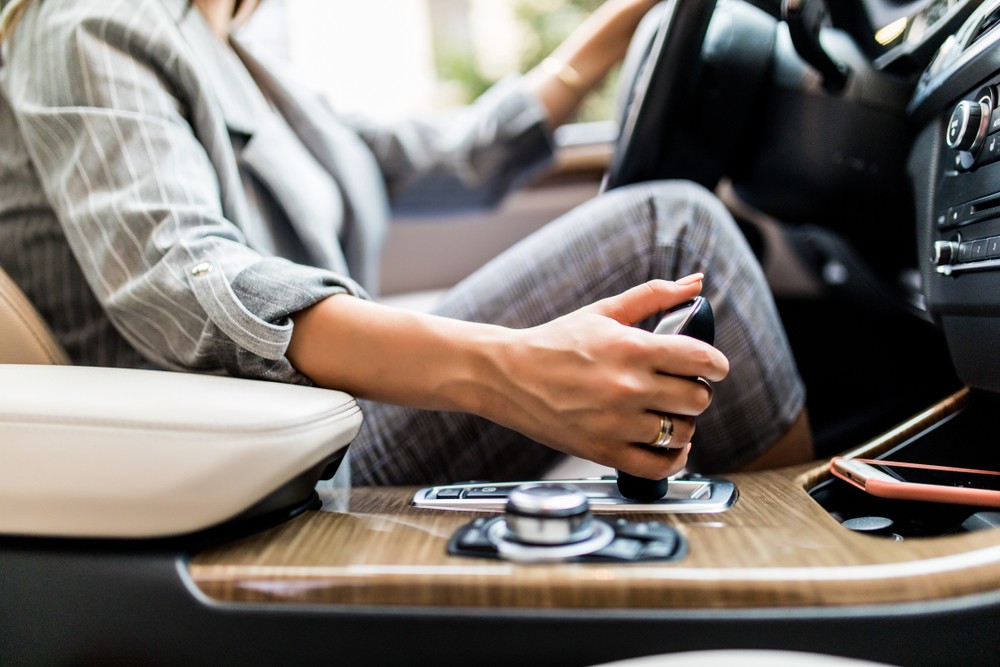

Learning to drive an automatic car is the quickest way for many new drivers to feel at home behind the wheel. There's no clutch, no stalling and much less to juggle at junctions. This 2026 guide from First Vehicle Leasing covers how to drive an automatic car step by step, what the selector letters mean, the licence rules and costs, and which current automatics suit new drivers.
Key Takeaways
- Use your right foot for both pedals, hold the brake whenever you select D or R, and only select P once the car has fully stopped.
- Automatics are mainstream: 26% of practical car tests in 2024/25 were taken in one, according to DVSA figures reported by the AA.
- Pass in an automatic and the DVLA adds code 78 to your licence, limiting you to automatics until you pass a manual test.
- In Great Britain the theory test costs £23 and the practical test £62 on weekdays or £75 on evenings, weekends and bank holidays (GOV.UK, September 2026).
- Every electric car, and almost every full or plug-in hybrid, is automatic, so an automatic licence covers most of the new cars now on sale.
What Do the Letters on an Automatic Gear Selector Mean?
The letters on an automatic gear selector tell the gearbox what you want it to do. P (Park) locks the transmission, R is reverse, N is neutral and D is drive, where the car chooses the gears for you. Many cars add S or M for sport or manual shifting, and electric cars often have a B setting for stronger braking.
Selectors now come in several forms: a traditional lever, a rotary dial, a row of buttons or a small stalk behind the steering wheel. The positions mean the same thing whichever layout your car uses.
| Setting | What it does | When to use it |
|---|---|---|
| P (Park) | Locks the transmission so the car can't roll | Only once stopped, before switching off |
| R (Reverse) | Engages reverse | From a standstill, foot on the brake |
| N (Neutral) | Disconnects drive from the wheels | Car washes or being pushed, never for coasting |
| D (Drive) | The car selects gears automatically | Almost all normal driving |
| S or M (Sport/Manual) | Holds gears longer, or lets you change with paddles or +/- | Hilly roads, overtaking, towing |
| B or L (Brake/Low) | Adds engine braking, or stronger regenerative braking in hybrids and EVs | Long descents and stop-start town traffic |
Regenerative braking means the electric motor slows the car and feeds energy back into the battery, so you use the brake pedal less.
How Do You Drive an Automatic Car Step by Step?
To drive an automatic, set your seat and mirrors, press the brake with your right foot and start the car. Keep holding the brake while you select D or R, release the parking brake, then ease off the brake so the car creeps forward before gently pressing the accelerator. Your left foot stays flat on the floor throughout.
Moving off
- Adjust your seat, steering wheel and mirrors, and fasten your seatbelt.
- Put your right foot firmly on the brake pedal (the wider one).
- Press the start button or turn the key. Most cars won't start unless the brake is pressed.
- Holding the brake, select D to go forwards or R to reverse.
- Release the parking brake. Many newer cars have an electronic parking brake that releases itself when you pull away with your seatbelt on.
- Check all around, lift your foot off the brake to let the car creep, then squeeze the accelerator gently.
Stopping and parking
- Ease off the accelerator and brake smoothly until the car stops.
- Keep your foot on the brake and select P.
- Apply the parking brake (a lever or a button, depending on the car).
- Switch off, and only then take your foot off the brake.
Look out for auto hold, a button that keeps the brakes on when you stop in traffic so you can rest your foot, and hill start assist, which stops the car rolling back on slopes.
Every electric car is automatic, so if you're thinking about an EV as your first car, the steps above are all you need.
Which Types of Automatic Gearbox Will You Find in 2026?
You'll come across six main types of automatic in 2026: traditional torque converters, continuously variable transmissions (CVT), dual-clutch gearboxes (DCT), automated manuals (AMT), hybrid systems and the single-speed drive in electric cars. They're all driven the same way, with just two pedals, but each feels slightly different at low speed.
| Gearbox type | How it feels | Typically found in |
|---|---|---|
| Torque converter | Smooth, gentle creep, ideal for learners | Larger and premium cars such as the BMW 3 Series |
| CVT / e-CVT | No noticeable gear changes; engine can drone when accelerating hard | Toyota hybrids including the Yaris and Prius |
| Dual-clutch (DCT) | Quick, crisp changes; can be slightly jerky when manoeuvring | Many Volkswagen Group cars, such as the Golf |
| Automated manual (AMT) | A manual gearbox changed by a computer; noticeable pause between gears | Some budget city cars |
| Full hybrid systems | Often pulls away silently on electric power | Honda Jazz, Renault Clio E-Tech |
| Electric single-speed | Instant, completely smooth pull with no changes at all | Every EV, such as the Renault 5 |
Is It Easier to Learn to Drive in an Automatic?
For most learners, yes. With no clutch to control and no gears to choose, lessons can focus on observation, road positioning and hazard awareness. That doesn't make the test itself easier, though: automatic pass rates have run around six percentage points below manual, possibly because some learners book their test before they're fully ready.
Automatics have gone from niche to normal. DVSA figures show just 6.1% of car tests were in automatics in 2012/13, rising to 26% in 2024/25, nearly 480,000 tests, and the AA Driving School expects that share to reach around 32% in 2026/27.
How much does it cost to learn in an automatic in 2026?
The official fees are the same whichever gearbox you choose. According to GOV.UK's driving test costs page, the car theory test is £23 and the practical test is £62 on weekdays or £75 on evenings, weekends and bank holidays. A first provisional licence from the DVLA costs £34 online or £43 by post. Lessons are the big cost: DVSA data published in 2026 put the most common hourly price at £36 to £40, and automatic lessons can cost a little more because fewer instructors offer them. You may need fewer hours overall, but there's no guarantee.
Are the rules for learners changing?
Possibly. The Department for Transport consulted from 7 January to 11 May 2026 on a minimum learning period for learner drivers of three or six months before the practical test. Any change would need new legislation, so for now you can still book your practical test as soon as you've passed your theory.
Will I be approved?
Five questions, no sign-up, and an honest answer before you apply for anything.
Check my eligibilityWhat Can You Drive With an Automatic-Only Licence?
If you pass your practical test in an automatic, the DVLA adds code 78 to category B on your licence. You can drive any automatic car, including every electric car and hybrid, but not a manual. To remove the restriction you pass a practical test in a manual car; you don't need a new provisional licence or another theory test.
Driving a manual on an automatic-only licence means you're driving without the correct entitlement, which can invalidate your insurance. If you're unsure what your licence covers, the DVLA's free "View your driving licence information" service on GOV.UK shows your categories and codes.
Choose an automatic if...
- You plan to drive a new, hybrid or electric car
- You'll mostly drive in towns and heavy traffic
- Clutch control is holding back your progress or confidence
- A physical condition makes a clutch pedal difficult
Consider a manual if...
- You'll hire cars abroad, where manuals are still common
- Your first car will be an older, cheaper used model
- A job may involve driving manual vans
- You want the widest possible licence from day one
What Mistakes Do New Automatic Drivers Make?
The most common automatic mistakes are using the left foot to brake, selecting P or R before the car has stopped, and coasting in neutral. Others include forgetting that the car creeps forward on its own and being caught out by kickdown. Each is easy to avoid once you know about it, and your instructor will look for all of them.
- Left-foot braking: keep your left foot on the footrest. Using two feet risks pressing both pedals at once.
- Changing direction while moving: always stop completely before selecting R, D or P.
- Coasting in N: the Highway Code warns that coasting reduces your control of the car. Leave it in D.
- Ignoring creep: in car parks, control your speed with the brake alone; you rarely need the accelerator.
- Kickdown surprises: pressing the accelerator hard makes the gearbox drop down a gear or more for a burst of speed, so be smooth.
- One-pedal driving in EVs: strong regenerative braking slows the car the moment you lift off. Practise somewhere quiet first.
Which Automatic Cars Suit New Drivers in 2026?
The best automatics for new drivers are compact, easy to see out of and in low insurance groups for their entry trims. Current examples include the Toyota Yaris and Honda Jazz hybrids, the MG3 Hybrid+ and the electric Renault 5. All come with two pedals as standard, so there's no risk of ending up with a manual by mistake.


Toyota Yaris
A self-charging hybrid with a smooth e-CVT gearbox and a compact footprint that's easy to park. See current deals on the Toyota Yaris page.
Honda Jazz
Tall, airy and very easy to see out of, with a gentle hybrid system that suits nervous drivers. View the Honda Jazz.
MG3 Hybrid+
A roomy supermini with a hybrid automatic and plenty of standard kit for the money. Check the MG3 page.
Renault 5
A small electric hatchback with instant, smooth pull and no gear changes at all, ideal if you can charge at home. See the Renault 5.


Insurance groups vary by trim, and a brand-new car can be expensive to insure for a newly qualified driver. Our leasing experts recommend getting insurance quotes on two or three shortlisted cars before you decide.
Can You Lease an Automatic Car as a New Driver?
Yes. Personal Contract Hire (PCH) is a rental: you pay an initial rental, then a fixed monthly rental, and hand the car back at the end. Funders mainly look at your credit history and affordability, and the monthly rental covers the gap between the car's price and its expected value at the end of the term, plus interest charges.
FVL is authorised and regulated by the FCA and is a BVRLA member. If you're getting a company car, fully electric cars carry a 4% Benefit in Kind (BIK) rate for 2026/27 under HMRC's published company car tax rates, and an EV through salary sacrifice can be even more tax-efficient. New to it all? Our guide to your first vehicle lease explains each step.
Cars in this article


Related guides
Leasing a Car as a Student or Young Driver: Your OptionsBEV vs PHEV vs Hybrid: Which One Suits You?Should I Lease an Electric Car? An Honest UK GuideShould I Lease or Buy an Electric Car?View all guidesFrequently Asked Questions
Ready to Drive Your First Automatic?
First Vehicle Leasing has spent over 25 years matching drivers with the right car. Tell us what you need and what you want to spend, and we'll show you the automatics that give you the most for your money. Call our team on 0333 003 3325 or browse the latest offers.
Sources
- Driving test costs - GOV.UK (DVSA)
- Introducing a minimum learning period for learner drivers - GOV.UK (Department for Transport)
- EV market hits new high but target gap remains - SMMT
Written by Andy Bell, First Vehicle Leasing.