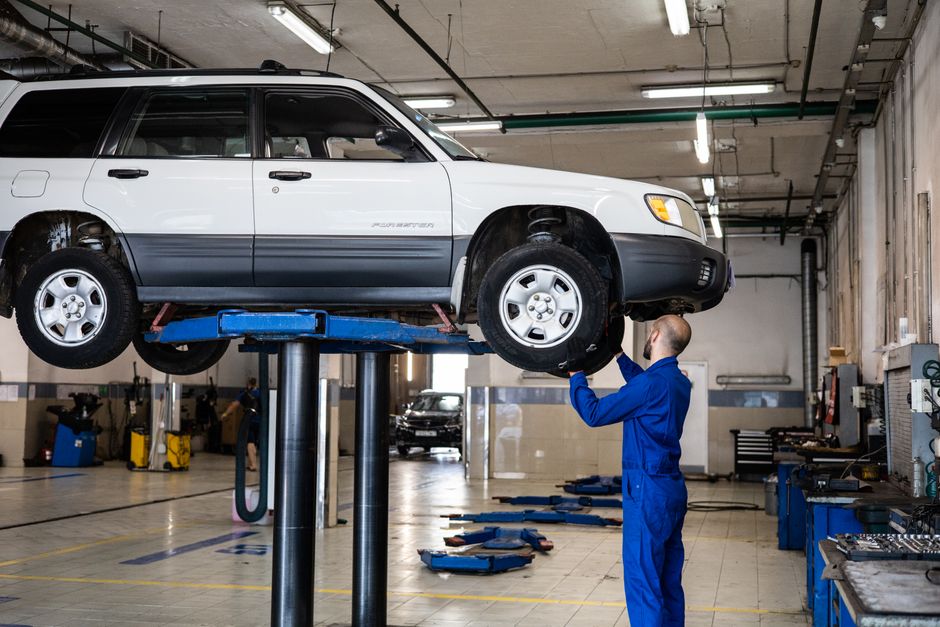
A maintenance package rolls the predictable running costs of your lease vehicle into the monthly rental: manufacturer-scheduled servicing, tyres, brake pads and discs, wiper blades, bulbs, batteries, MOTs where the term needs one, and mechanical or electrical repairs caused by fair wear and tear. It does not cover accident damage, driver error, fuel, insurance or misfuelling.
What's in this guide
- What does a maintenance package cover?
- What isn't covered by a maintenance package?
- Maintenance package vs manufacturer warranty
- Does it include MOTs, road tax and breakdown cover?
- How does a maintenance package work day to day?
- How much does maintenance cost and is it worth it?
- Is maintenance worth adding to an electric car lease?
- Business leases: VAT and company car tax
- Should you add maintenance? A decision framework
- Frequently asked questions
Key Takeaways
- Covered: scheduled servicing, tyres, brake pads and discs, wipers, bulbs, batteries, exhausts, suspension wear, and MOTs where your term runs past the vehicle's third birthday.
- Not covered: accident damage, kerbed alloys, cracked windscreens, misfuelling, lost keys, valeting, fuel, insurance, and any charge for damage beyond fair wear and tear at handback.
- A maintenance package is not a warranty. The manufacturer warranty fixes faults; maintenance covers the things that simply wear out.
- Under the BVRLA Fair Wear and Tear Standard, a returned vehicle must have been serviced to the manufacturer's schedule - maintenance guarantees that box is ticked.
- The price is quoted per vehicle, term and mileage. Ask us for the maintenance figure separately so you can weigh it against what servicing and tyres would actually cost you.
What does a maintenance package cover?
It covers the routine, predictable upkeep of the vehicle: servicing to the manufacturer's schedule, replacement tyres, brake pads and discs, wiper blades, bulbs, the 12-volt battery, exhaust and suspension components, and mechanical or electrical repairs that arise through normal use. MOT testing is included where your contract term requires one.
Exact wording varies by funder, so read the maintenance terms attached to your agreement rather than assuming. That said, the shape of the cover is fairly consistent across the market. According to the BVRLA's consumer leasing FAQs, a fully maintained contract covers servicing, replacement tyres and other consumable parts for a fixed monthly cost.
The typical inclusion list
Scheduled servicing
Every service the manufacturer specifies, at the correct interval, at an approved garage, using the right parts and lubricants. Oil, filters, plugs, brake fluid and the associated inspections are all part of it.
Tyres
Replacement tyres worn through normal driving, fitted to the manufacturer's specification for size, type and speed rating. The legal minimum tread depth in Great Britain is 1.6mm across the central three-quarters of the tread; many funders and their tyre partners replace earlier, commonly around 2mm, so the vehicle stays comfortably legal.
Brakes and wear items
Pads, discs, wiper blades, bulbs, the 12-volt battery, exhaust components, and suspension parts that wear out. On a heavier car or a high-mileage contract these are the items most likely to come round twice.
MOT and repairs from wear
The MOT test itself where your term needs one, plus mechanical and electrical repairs - parts and labour - arising from fair wear and tear rather than an incident.
One benefit that gets undersold: the funder holds the service record. Under BVRLA fair wear and tear standards, a vehicle must be returned having been serviced in line with the manufacturer's schedule, with the evidence to prove it. Miss a service on a customer-maintained lease and you can face a charge at handback on top of the repair bill. With maintenance included, that's handled and logged for you.
What isn't covered by a maintenance package?
Anything caused by an event rather than by wear. Accident damage, kerbed alloys, cracked or chipped windscreens, punctures from road debris, misfuelling, lost keys, missing charge cables, valeting and cosmetic damage all sit outside the package - as do fuel, electricity, insurance and any end-of-contract charge for damage beyond fair wear and tear.
| Item | Maintenance package | Who picks it up instead |
|---|---|---|
| Scheduled service | Included | - |
| Tyres worn through normal use | Included | - |
| Puncture, sidewall damage, kerbed alloy | Not included | You, or tyre & alloy cover |
| Brake pads and discs | Included | - |
| Windscreen chip or crack | Not included | Your motor insurer (glass cover) |
| Accident or collision damage | Not included | Your motor insurer |
| Misfuelling, wrong oil, lost keys | Not included | You |
| Scuffs, dents and scratches beyond fair wear and tear | Not included | You, or SMART repair cover |
| Vehicle Excise Duty (road tax) | Not part of maintenance | Included in the lease rental itself |
Two of those gaps have their own products, which is where people get confused about overlap. Tyre damage from a pothole or a nail is not wear, so it falls to you - our guide to tyre and alloy insurance covers where that's worth having. Bumper scuffs and door dings are handled by cosmetic (SMART) repair cover, not by maintenance. And if you want the whole picture on end-of-contract exposure, read how to avoid unexpected bills on a lease.
Maintenance package vs manufacturer warranty
A warranty fixes things that go wrong; maintenance covers things that wear out. The manufacturer warranty repairs defects in materials or workmanship at no cost to you for its stated term. It will not pay for a service, a set of tyres or a worn brake disc - those are consumables, and they're precisely what a maintenance package exists to cover.
| Cost | Manufacturer warranty | Maintenance package |
|---|---|---|
| Failed water pump at 28,000 miles | Covered (defect) | Covered if outside warranty |
| Annual or interval service | Not covered | Covered |
| Worn tyres | Not covered | Covered |
| Brake pads and discs | Not covered | Covered |
| Term length | Varies by brand, commonly 3 years | Full length of your contract |
Worth knowing: a lapsed or non-approved service can invalidate a warranty claim. So the two products aren't rivals - the maintenance package is what keeps the warranty valid in the first place.
Does it include MOTs, road tax and breakdown cover?
MOTs: yes, where your term needs one. Road tax: not part of maintenance - Vehicle Excise Duty is included in the lease rental itself for the full contract. Breakdown: usually yes, though the first year or more often comes from the manufacturer's own roadside assistance, with the funder's cover continuing beyond it.
So when does a lease car actually need an MOT?
According to the DVSA rules published on GOV.UK, most cars need their first MOT three years from registration, then annually. On a 24 or 36-month contract from new, the car goes back before an MOT is ever due. On a 48-month contract you'll need one in the final year - the BVRLA makes the same point in its consumer guidance. That's a genuine reason to look harder at maintenance on longer terms.
Road tax trips people up because it's bundled but invisible. It's in the rental, for the life of the contract - you don't renew it and you don't pay the funder separately for it. Our explainer on how a lease works from delivery to handback sets out what else comes as standard.
How does a maintenance package work day to day?
You get a maintenance booklet or portal login and a booking number at the start of the contract. When a service falls due, or something wears out, you call that number, the provider authorises the work at an approved garage near you, and the garage invoices the funder directly. You don't pay and claim back - there's no bill to you at all.
- Use approved garages only. Going to your own independent and asking for reimbursement usually isn't how these packages work, and unapproved work can create problems at handback.
- Authorisation happens before the work. If a garage finds something outside the cover - kerb damage on an alloy, say - they'll tell you before proceeding and that item is chargeable to you.
- Courtesy cars are not automatic. Some funders include one for extended repairs, some don't. Ask before you sign if it matters to you.
- Mileage matters. The package is priced on the mileage you declared. Materially over-running it can mean an adjustment, in the same way the rental itself does.
Ask for the maintenance figure on its own
When we quote a maintained lease, we can show you the rental with and without maintenance so you can see exactly what the cover costs per month. Do that arithmetic before you decide - it's a far better test than any general rule about whether packages are "worth it". Our team will price it either way on any vehicle.
How much does maintenance cost and is it worth it?
There's no standard price. Maintenance is quoted per vehicle, contract length and annual mileage, because those three things determine how many services, tyres and brake sets the funder expects to fund. A three-year, 8,000-mile city car costs a fraction of what a four-year, 25,000-mile executive saloon does.
The honest answer on value is that it depends on your mileage, your term and the car. A low-mileage 24 or 36-month lease on a modest hatchback may need one or two services and no tyres - in that case you may well spend less paying as you go. Push the mileage up, or the term out to 48 months, or choose a premium brand with expensive servicing and 20-inch tyres, and the package usually earns its keep.
Where we see it pay off
- High mileage. Above roughly 15,000 miles a year you're into a second set of tyres and a second brake replacement on most cars.
- 48-month contracts. More services, an MOT, and wear items reaching the end of their life inside your term rather than the next owner's.
- Premium and performance models. Large-diameter, low-profile tyres and franchised-dealer labour rates are where uncovered bills sting.
- Vans and business fleets. Downtime costs money, and fixed monthly cost per vehicle makes budgeting straightforward. Have a look at our van leasing deals if that's your situation.
- Anyone who hates surprise bills. A perfectly legitimate reason. You're buying budget certainty, and that has value even if the sums come out level.
Where it's often not worth it: short, low-mileage contracts on cheap-to-run cars, where the warranty covers faults and you'll realistically face one service and nothing else.
Is maintenance worth adding to an electric car lease?
Often it's cheaper than on a petrol or diesel equivalent, because an EV has no oil changes, no spark plugs, no exhaust and no cambelt, and regenerative braking spares the pads. But EVs are heavy and quick off the line, which chews through tyres - and tyres are the single biggest wear cost on most electric cars.
Servicing an EV is lighter work, but it isn't nothing: cabin filters, brake fluid, coolant for the battery pack on some models, and inspections all remain scheduled items. The high-voltage battery itself sits under a separate manufacturer battery warranty, typically covering a state-of-health threshold over a set period, and is not a maintenance item.
Worth noting for handback: the BVRLA's updated car standard asks for EVs to be returned with charge in the battery and with their charging cables present and undamaged. A missing cable is a chargeable item, not a maintenance one. Our electric car guide goes into the running-cost picture in more depth.
Business leases: VAT and company car tax
On Business Contract Hire (BCH), VAT treatment differs between the finance rental and the maintenance element. VAT on the finance rental of a car used for both business and private journeys is generally recoverable at 50%, while VAT on a separately identified maintenance charge is normally recoverable in full - which is why funders itemise it on the invoice.
That's a real, practical reason for a VAT-registered business to take a maintained contract, though the treatment depends on how the agreement is documented and on your own VAT position, so check with your accountant. For vans used for business, the rules differ again.
On company car tax, the taxable benefit is calculated from the car's P11D list price and its CO2 emissions band under HMRC's published company car tax rates - not from whether maintenance is bundled into the rental. Petrol and diesel cars sit at roughly 15-37% of list price depending on emissions, while zero-emission cars are on 4% for the 2026/27 tax year, rising in later years under the published schedule. Adding a maintenance package doesn't change that percentage.
If you're an employer or employee looking at electric company cars, the tax gap is where the money is. See our salary sacrifice car scheme page and our business leasing options for how maintained contracts are usually structured for fleets.
Should you add maintenance? A decision framework
Work through four questions: how many miles you'll cover a year, how long the contract runs, how expensive the car is to service and shoe, and how much you value a fixed monthly cost. If two or more point towards heavy wear, take the package. If all four point the other way, decline it and budget for servicing yourself.
Take it if
You drive 15,000+ miles a year, you're on a 48-month term, the car is premium or performance, you run a business vehicle you can't afford to have off the road, or you simply want one predictable payment.
It's finely balanced if
You're on a 36-month term at 10,000-15,000 miles a year in a mainstream car. Get the monthly maintenance figure, multiply by the term, and compare it against a dealer quote for two services plus a set of tyres.
Skip it if
You're doing under 10,000 miles a year on a 24 or 36-month contract in a small, cheap-to-service car. The warranty handles faults, and you're unlikely to reach a tyre change.
Before you sign, check these five things
- Is the maintenance figure shown separately from the finance rental?
- Does it include tyres, and from what tread depth are they replaced?
- Does the term run past the vehicle's third birthday - if so, is the MOT included?
- Is breakdown cover included for the full term, or only after the manufacturer's assistance ends?
- What happens if you exceed the declared mileage - is the maintenance element adjusted?
Based on our experience arranging leases for both private and business drivers over more than 25 years, the customers who regret declining maintenance are almost always the high-mileage ones. The customers who regret taking it are the ones who did 6,000 miles a year in a supermini. Match the cover to how you actually drive, not to how you might.
Not sure whether to add maintenance? Talk it through
Tell our team your annual mileage, your preferred term and the vehicle you're considering, and we'll price the lease both ways so you can see the real cost of the cover. No pressure either way - if the numbers say decline it, we'll say so. Call 0333 003 3325 or browse the current offers.
Frequently Asked Questions
Sources
- Leasing: Frequently Asked Questions - British Vehicle Rental and Leasing Association
- Fair Wear and Tear Standards - British Vehicle Rental and Leasing Association
- Getting an MOT - GOV.UK
Written by the leasing team at First Vehicle Leasing. We've arranged personal and business vehicle leases across the UK for over 25 years. FVL is authorised and regulated by the Financial Conduct Authority and is a member of the BVRLA. This guide is general information, not financial or tax advice - please take professional advice on your own circumstances.
Will I be approved?
Five questions, no sign-up, and an honest answer before you apply for anything.
Check my eligibility