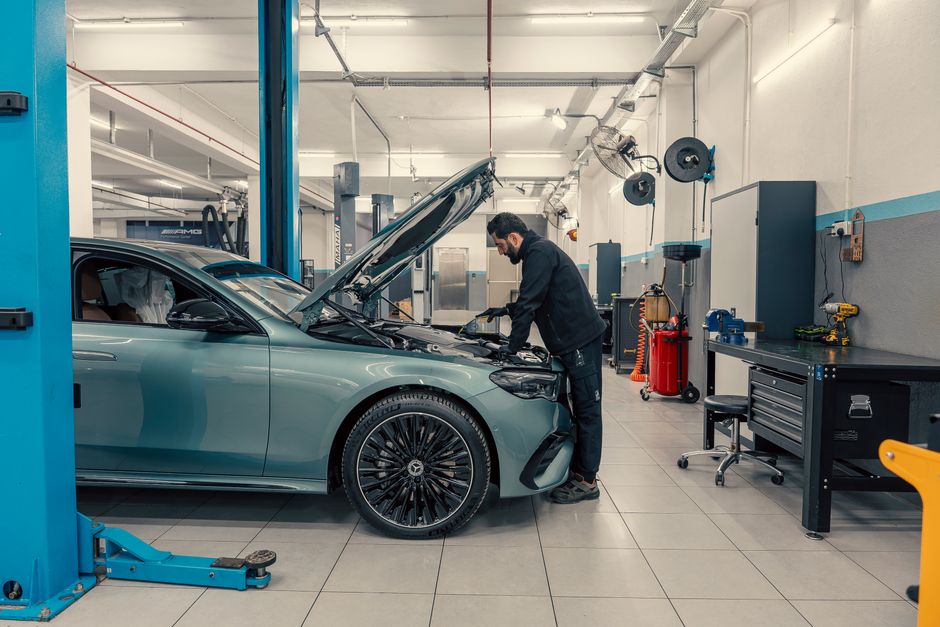
The honest answer: on a 24 or 36 month lease at average mileage on a brand-new car, a maintenance package usually costs a little more than the servicing you'd have paid for anyway. You're buying convenience and a fixed budget, not a discount. On longer terms, high mileage, premium models and business fleets, the maths changes - and it can genuinely pay.
What's in this guide
- Is a lease maintenance package worth the extra?
- What does a maintenance package actually cover?
- What will you pay for servicing without one?
- When is a maintenance package worth adding?
- Does maintenance protect you at handback?
- Is maintenance better value on a business lease?
- Do electric cars need a maintenance package?
- Maintenance versus the other lease add-ons
- Your five-minute decision checklist
- Frequently Asked Questions
Key Takeaways
- A maintenance package is an optional monthly add-on covering servicing, wear items such as tyres, brakes, wipers and bulbs, and usually MOTs and breakdown cover.
- On a 24 or 36 month lease at average mileage, a brand-new car typically needs one or two services and little else - so the package is usually a small premium for convenience, not a saving.
- It tilts towards good value at 48 months, at high mileage, on premium or large-wheeled cars with expensive tyres, and on vans.
- VAT-registered businesses can normally recover 100% of the VAT on a separately itemised maintenance element, against only 50% on the rental for a car.
- Maintenance does not cover accident damage, kerbed alloys, misfuelling or vandalism - that's insurance and end-of-contract damage territory, not servicing.
Is a Lease Maintenance Package Worth the Extra?
For most personal leases - 24 or 36 months, 8,000 to 12,000 miles a year, brand-new car - a maintenance package is a convenience purchase rather than a money-saver. You'll usually pay a little more over the term than the servicing would have cost. Beyond three years or 15,000 miles a year, it often wins.
That's the straight version, and we'd rather say it than pretend otherwise. A brand-new car on a three-year contract at ordinary mileage tends to need two services, a set of wiper blades, maybe a set of front tyres if you're heavy on the throttle. No MOT, because in Great Britain the first MOT falls due three years after first registration. There isn't much for the package to pay for.
What you're actually buying is the removal of variance. One monthly figure that covers the car, the servicing and the wear items, with nothing landing unexpectedly in March. Plenty of people are happy to pay a modest premium for that, and it's a perfectly rational thing to buy - just buy it with your eyes open rather than because a box was ticked for you.
The picture flips when the car is going to wear things out. A 48-month term crosses the MOT threshold and almost certainly needs tyres and brakes. A 25,000-mile-a-year driver will get through consumables at a rate that makes the fixed monthly price look cheap. And a performance saloon on 20-inch wheels can burn through a set of tyres that costs more than a year of maintenance payments.
What Does a Maintenance Package Actually Cover?
A maintenance package covers scheduled servicing to the manufacturer's schedule, replacement of routine wear items - tyres, brake pads and discs, wiper blades, bulbs, batteries - and, on longer contracts, the MOT. Most funders (the finance company that owns the car) include roadside assistance too. It does not cover damage.
Cover varies by funder, so the schedule attached to your agreement is the document that matters, not a marketing page. That said, the shape of it is fairly consistent across the market.
| Item | Typically included | Notes |
|---|---|---|
| Scheduled servicing | Yes | To the manufacturer's schedule, at franchised or approved garages |
| Tyres | Usually | Fair wear replacement; some funders cap the number per term |
| Brake pads and discs | Yes | Where worn through normal use |
| Wipers, bulbs, battery | Usually | Routine consumables |
| MOT test | Yes, if the term reaches it | Only relevant on terms beyond 36 months |
| Roadside assistance | Usually | Level of cover differs by funder |
| Puncture from a nail or kerb impact | No | Treated as damage, not wear |
| Accident damage, vandalism, misfuelling | No | Insurance, or your own pocket |
| Windscreen chips and cracks | No | Normally a comprehensive insurance claim |
| Kerbed alloys and paint scuffs | No | Assessed at handback under fair wear and tear standards |
One point that catches people out: a maintenance package is not a warranty, and it isn't insurance either. Mechanical faults on a new car are covered by the manufacturer's warranty regardless of whether you took maintenance. The package pays for the predictable stuff - the things that wear out because you drove the car.
So what happens if I don't take one?
Nothing dramatic. You book the car into a franchised dealer or a VAT-registered garage that works to the manufacturer's schedule, you pay the invoice, and you keep the record. That last part is not optional - the service history is checked when the car goes back. We cover the handback process in more detail in our guide to what happens at the end of your lease.
The Question Nobody Asks Until It's Too Late
If you skip maintenance, servicing still has to happen on schedule. It isn't a saving you can spend elsewhere and forget about. A missed or late service can invalidate warranty cover and will show up as a gap in the service record at handback, which the funder can charge for.
Whichever way you go, put the service dates in your calendar the week the car arrives. That single habit prevents the most common - and most avoidable - end-of-contract charge we see.
What Will You Pay for Servicing Without One?
Without a package you're funding services, tyres, brakes and - on longer terms - the MOT yourself, as and when they fall due. The only reliable way to judge the package is to price those items for your specific model and term, then compare the total against the monthly add-on multiplied by the number of payments.
Here's the calculation, and it takes about ten minutes:
- Check the manufacturer's service schedule for your model - how many services fall inside your term at your mileage?
- Ring your nearest franchised dealer and ask for the price of each of those services on that exact model.
- Price a set of tyres in the size fitted to the trim you're ordering. Not the base model - the size on your car.
- Add an MOT if your term runs past three years. Under GOV.UK's published MOT fees, the maximum a test station can charge for a car is £54.85, and many charge less.
- Compare that total with the maintenance cost across the full term.
An illustrative example, with round numbers. Say maintenance is quoted at £25 a month on a 36-month contract. That's £900 over the term. If your model needs two services in that time and you're unlikely to need tyres before handback, you'd need those two services to come in above £900 for the package to break even - and on a mainstream hatchback, they usually won't. Change one variable - 48 months instead of 36, or 20,000 miles a year instead of 10,000 - and the same £900 starts to look like decent value, because now you're adding tyres, brakes and an MOT to the other side of the ledger.
These figures are purely illustrative. Your quoted maintenance rate depends on the vehicle, term and mileage, so use your own numbers.
When Is a Maintenance Package Worth Adding?
Add maintenance when the vehicle will wear things out inside the term, when a breakdown would cost you money, or when a fixed monthly figure is genuinely worth more to you than the few pounds' difference. Skip it on short, low-mileage contracts on mainstream cars where the servicing burden is light.
Add it if…
- Your term is 48 months or longer
- You drive more than about 15,000 miles a year
- The car has 19-inch wheels or larger, or performance-rated tyres
- You're leasing a premium badge with premium servicing prices
- You're leasing a van, or the vehicle earns you money when it's working
- A £700 bill arriving unannounced would genuinely hurt
Probably skip it if…
- Your term is 24 or 36 months on a new car
- You do under 10,000 miles a year
- It's a mainstream model with modest servicing costs
- The model comes with a manufacturer service plan already
- You'd rather keep the monthly payment as low as possible
- You're comfortable booking and paying for servicing yourself
Two of those variables - term and mileage - do most of the work. If you haven't settled them yet, read our guides on what lease length to choose and picking the right annual mileage first, then come back to this decision. Deciding on maintenance before you've fixed the term is doing it in the wrong order.
Does Maintenance Protect You at Handback?
Partly. A maintenance package guarantees a complete, on-schedule service history and keeps consumables like tyres and brakes within acceptable limits - two of the areas most often charged for. It does nothing at all for bodywork damage, kerbed wheels, scratches or a missing key, which are assessed separately.
Under BVRLA fair wear and tear standards - the industry-wide condition standard published by the British Vehicle and Rental Leasing Association, the trade body FVL belongs to - a returned vehicle must be roadworthy, complete with its keys and documentation, and serviced in line with the manufacturer's schedule with the record to prove it. Tyres must meet the legal minimum tread depth of 1.6mm across the central three-quarters of the tread, and be free from damage.
So maintenance removes a category of risk. It doesn't remove the inspection. If you scrape an alloy on a Sheffield kerb in month 14, that's yours to sort out - which is exactly the sort of thing the products covered in our protection and add-ons guides are designed for.
A practical habit worth adopting either way: walk round the car properly about three months before handback, in daylight, with it clean. Small repairs sorted early are almost always cheaper than end-of-contract charges applied later.
Is Maintenance Better Value on a Business Lease?
Often, yes - and the reason is VAT. Where the maintenance element is itemised separately on the invoice, a VAT-registered business can normally recover 100% of the VAT on it, while VAT on the rental element of a car lease is restricted to 50% where the car is available for private use. That materially narrows the real cost gap.
According to HMRC's guidance in VAT Notice 700/64, the 50% input tax block applies to the supply of the car itself. HMRC has accepted, under an administrative agreement with the leasing industry, that where services such as repairs and maintenance are optional and separately described and quantified on the invoice, the block doesn't apply to them. Your accountant will want to see that split on the invoice - most funders present it that way as standard.
There's a second, less glamorous reason fleets take maintenance almost by default: it turns an unpredictable cost line into a fixed one, and it removes the administrative job of chasing drivers to book services. If you're running more than a handful of vehicles, that alone tends to justify it. Our business leasing pages set out how BCH works alongside the tax treatment.
Do Electric Cars Need a Maintenance Package?
Electric vehicles have fewer moving parts, no oil changes and, thanks to regenerative braking, brake components that often last far longer. Servicing is usually cheaper and lighter. But EVs are heavy and instant-torque, so tyres wear faster - which is where an EV maintenance package earns most of its money.
In practice, the EV decision comes down to tyres and mileage. A low-mileage EV on modest wheels rarely justifies the add-on over three years. A heavy, fast, high-mileage EV on 20-inch rubber quite possibly does, because a set of tyres for it is not a small invoice.
Worth knowing if you're leasing through work: on a salary sacrifice scheme, maintenance is normally bundled into the arrangement as standard rather than being an optional extra, along with insurance and tyres. If that applies to you, the decision has effectively been made - see our salary sacrifice page for how those schemes are put together, and browse current electric car lease deals if you're weighing up an EV.
Maintenance Versus the Other Lease Add-ons
Maintenance is one of several optional extras offered alongside a lease, and they solve different problems. Confusing them is the most common mistake we see. Maintenance handles predictable wear; insurance handles accidents; gap protection handles a total loss; alloy and paint products handle cosmetic damage at handback.
| Add-on | What it solves | Who it suits |
|---|---|---|
| Maintenance package | Servicing, tyres, brakes, MOT, breakdown | Long terms, high mileage, vans, fleets |
| GAP protection | The shortfall if the car is written off or stolen | Anyone who couldn't absorb a shortfall |
| Alloy and cosmetic cover | Kerbed wheels, small scuffs and dents | City drivers, tight parking, big wheels |
| Motor insurance | Accidents, theft, third-party liability | Legally required for every driver |
Only one of those is compulsory. The rest are judgement calls, and the right answer differs from person to person. Our protection and add-ons guides go through each in detail.
Your Five-Minute Decision Checklist
Run through these six questions before you tick or untick the maintenance box. If you answer yes to three or more, the package is likely worth the extra. Two or fewer, and you're probably better off keeping the monthly payment down and paying for servicing as it falls due.
Six questions
- Is my contract 48 months or longer?
- Will I cover more than 15,000 miles a year?
- Does the car sit on 19-inch wheels or larger, or performance tyres?
- Is it a premium or performance model with dealer servicing to match?
- Would an unexpected bill of several hundred pounds cause me a real problem?
- Am I VAT-registered and leasing through the business?
Then do the arithmetic from the servicing costs section above with your own quoted figures. Ten minutes on the phone to a dealer settles it far more reliably than any rule of thumb, including ours.
And if you want to sanity-check the underlying deal before you start adding options to it, our guide on how to compare lease deals covers the like-for-like comparison that actually matters. Compare the base rental first, then decide on maintenance separately - otherwise you're comparing two different products.
Not Sure Which Way to Go? Talk It Through
Our team arranges thousands of contracts a year, and we'll tell you honestly when maintenance isn't worth it on your particular car and term. No pressure, no ticked boxes you didn't ask for. Just the numbers for your vehicle, so you can decide.
Call our experts on 0333 003 3325, or browse the current offers and we'll price maintenance both ways.
Frequently Asked Questions
Sources
- Getting an MOT: when your vehicle needs testing and maximum test fees - GOV.UK
- Fair wear and tear standards and industry guidance - British Vehicle Rental and Leasing Association (BVRLA)
- Motoring expenses (VAT Notice 700/64) - HMRC / GOV.UK
- Administrative agreements with trade bodies (VAT Notice 700/57) - HMRC / GOV.UK
Written by the First Vehicle Leasing team. FVL is a UK vehicle leasing broker with over 25 years' experience arranging personal and business contract hire, authorised and regulated by the Financial Conduct Authority and a member of the BVRLA. Our team reviews these guides regularly to keep the figures and regulations current.
Will I be approved?
Five questions, no sign-up, and an honest answer before you apply for anything.
Check my eligibility