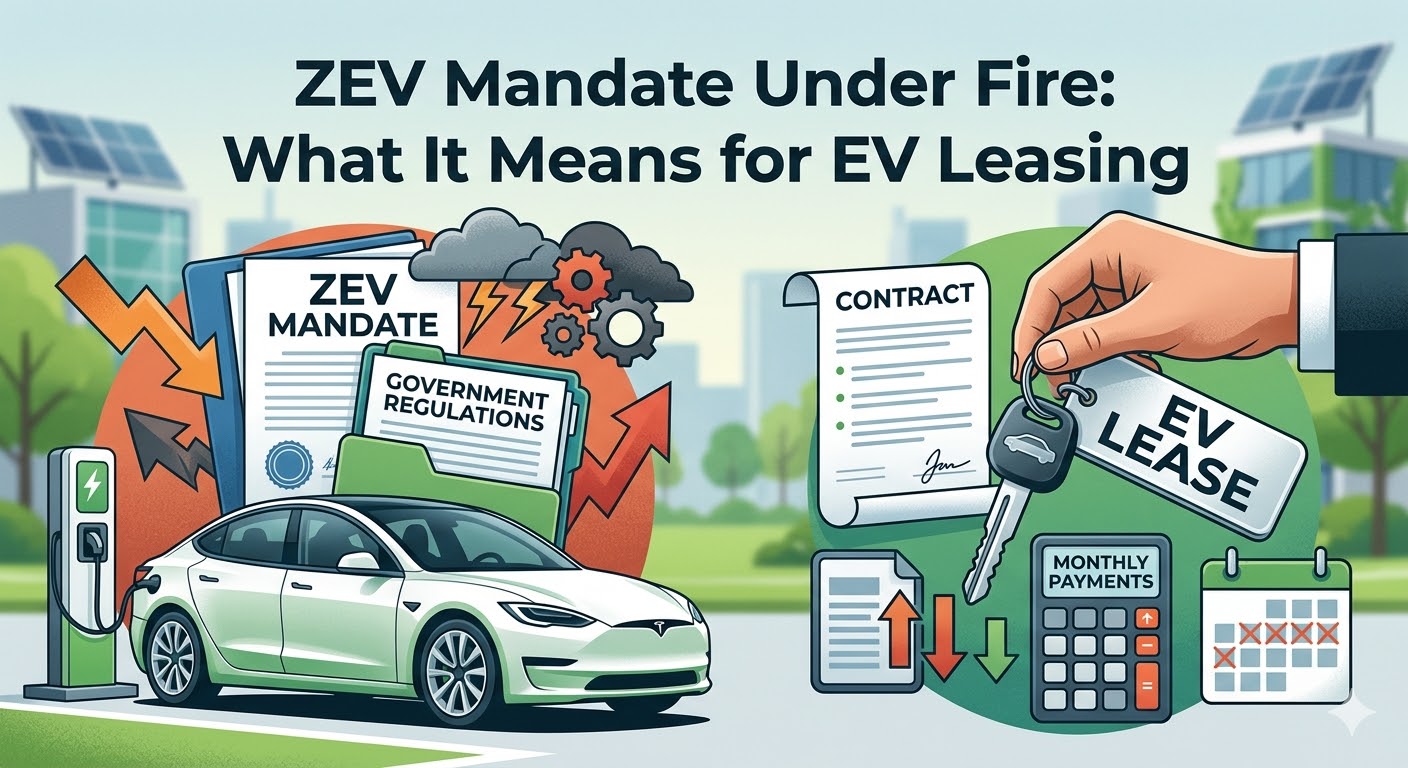

The pressure on EV targets is real – and it's shaping lease deals right now
The UK's car industry hit a breaking point last week. At the SMMT Electrified conference in London, manufacturers from Stellantis to Volkswagen lined up to tell the government that its electric vehicle sales targets aren't working the way they were planned. The message was blunt: building and selling EVs in the UK isn't profitable under current conditions, and something needs to change.
At First Vehicle Leasing, we've been watching this tension build for months. But here's the thing – while manufacturers are losing money on every EV they sell, the people actually benefiting from all this are leasing customers. The discounts being thrown at electric cars right now are historically unusual, and they're feeding directly into lower monthly rentals. So what's really going on, and how long can it last?
Explore our electric car lease deals
Key Takeaways
- The SMMT and major manufacturers are calling for an immediate review of the UK's Zero Emission Vehicle (ZEV) mandate – the regulation requiring 33% of new car sales in 2026 to be electric.
- Manufacturers have collectively spent over £10 billion in discounts across the past two years – averaging £11,000 per EV sold – to try to hit sales targets.
- The government has confirmed it won't publish the results of its ZEV mandate review until early 2027, despite industry pressure to act sooner.
- Current EV market share sits around 22-24%, well short of the 33% target for 2026 – meaning even deeper discounting is likely through the rest of the year.
- For leasing customers, this environment means some of the most competitive EV lease rates we've seen, particularly on models eligible for the Electric Car Grant of up to £3,750.
What's actually happening with the ZEV mandate?
The Zero Emission Vehicle (ZEV) mandate – introduced in January 2024 – requires car manufacturers to sell an increasing share of zero-emission vehicles each year. Miss the target, and you face a fine of £12,000 for every non-compliant car sold over the limit. The targets started at 22% of new car sales in 2024, rose to 28% in 2025, and this year sit at 33%.
The problem? Actual demand isn't keeping pace. In the first two months of 2026, electric cars have taken around a 22% market share. That's a long way from 33%. And the targets only get steeper from here – 38% in 2027, then a sharp jump to 52% in 2028.
Rather than paying fines, manufacturers have been pouring money into discounts to push EVs out the door. According to SMMT data, the industry has funded more than £10 billion in EV discounts over the past two years. That works out to roughly £11,000 per electric car sold. VW's UK sales boss Martin Sander warned at the conference that this level of discounting is "unsustainable" and will eventually push up the prices of petrol and diesel models as manufacturers try to recoup losses.
The government's position? It has acknowledged the review is needed but confirmed that results won't be published until early 2027. Minister Keir Mather stated the government is "resolutely behind" the transition, but the SMMT's Mike Hawes countered that waiting until 2027 is "not an option."
What this means for leasing
Right, so how does this boardroom battle affect someone looking at a 36-month personal lease on an electric hatchback? Quite a lot, actually.
Monthly rentals are being pushed down
Those manufacturer discounts don't just benefit people buying outright. When a manufacturer reduces the cost of a vehicle, the whole leasing calculation shifts. The capitalised cost drops, the residual value (what the car is expected to be worth at the end of your lease) adjusts, and your monthly payment comes down. We're seeing this play out across plenty of models right now – particularly in the £25,000-£40,000 bracket where the ZEV mandate pressure is most intense.
Residual values are in flux
Here's something most people don't think about. Heavy discounting today can weaken used EV values down the line – because buyers compare against what they could get a new model for. That's a headache for finance houses setting residual values on three or four-year leases. Some funders are being cautious, which can slightly push up monthly costs. Others are more bullish, betting that the used EV market will firm up as demand broadens. The net effect? It varies model by model, so getting a quote tailored to the exact car you want has never been more important.
The BIK tax advantage remains enormous
Whatever happens with the ZEV mandate review, the Benefit in Kind (BIK) tax position for electric company cars is locked in and isn't part of the debate. For the 2025/26 tax year, fully electric cars attract a BIK rate of just 3%, rising to 4% in 2026/27 and 5% in 2027/28. Compare that with 25-37% for a petrol or diesel equivalent. For a 40% taxpayer driving a £40,000 EV as a company car, you're looking at annual BIK tax of around £480 at 3% – versus £4,800 or more for a comparable petrol model at 30%. That gap is massive and it's not going anywhere soon.
This is exactly why salary sacrifice schemes remain such a powerful option for employees with access to them. The combination of low BIK rates plus manufacturer discounts plus the Electric Car Grant can reduce the effective monthly cost of driving an EV by 40-50% compared with a personal lease or outright purchase.
BIK rates shown are for the 2025/26 and 2026/27 tax years. Subject to change by HMRC. Always confirm rates with your employer or tax adviser.
Practical advice: what should you do right now?
If you're a company car driver or salary sacrifice candidate
Honestly, the financial case for going electric through your employer has rarely been stronger. BIK rates are still near their floor, manufacturers are discounting hard, and the Electric Car Grant offers up to £3,750 off qualifying EVs priced under £37,000. The grant applies to leased vehicles too – it's deducted before your monthly payments are calculated. Models like the MG4, Volkswagen ID.3, Citroën ë-C3 and Renault 5 all fall into that sweet spot.
One thing to keep in mind: BIK rates are rising by 1% per year through 2027/28, then 2% per year after that, reaching 9% by 2029/30. If you lock in a 36 or 48-month lease now, you're getting the best of the current BIK window for the bulk of your contract. Wait another year and you'll start the lease at 4% or 5% instead of 3%.
If you're a personal lease customer
You won't benefit from the BIK savings, but you will benefit from the aggressive pricing manufacturers are throwing at EVs. We're seeing personal lease deals on electric hatchbacks that would have been unthinkable two years ago. In our experience, roughly 60% of customers who come to us unsure about EVs end up going electric once they see the monthly figures side by side with a petrol equivalent – the total cost of ownership, including cheaper charging and lower servicing, tips the balance.
That said, if your annual mileage is very high – say, over 20,000 miles – or you don't have access to home charging, a plug-in hybrid (PHEV) might still be a more practical choice. PHEVs are seeing surging demand right now too, with registrations up over 43% year-on-year. Have a look at our petrol, diesel or electric guide for help working out which fuel type suits your situation.
Should you wait for better deals?
This is the question we get asked most at the moment. Our view: probably not. March is traditionally a peak month for new registrations – and manufacturers are under enormous pressure to hit their ZEV targets this quarter. That typically means the best deals land now, not later. If the mandate is eventually relaxed, the incentive for manufacturers to discount as aggressively will reduce. The sweet spot might be right now.
| EV BIK rate | 3% (2025/26), 4% from April 2026 | Confirmed rising to 9% by 2029/30 |
| Model choice | 150+ electric models available in UK | Expanding further as new entrants arrive |
| Lease pricing pressure | Strong downward pressure on EV rentals | Could stabilise or drift upward |
Prices correct as of March 2026 and subject to change. Lease examples subject to credit approval and status.
The bigger picture: where is this heading?
It's worth stepping back a moment. The ZEV mandate isn't under attack from people who oppose electric cars. The SMMT and the manufacturers have been clear: they're committed to electrification. The argument is about pace. The targets were set in 2021, when battery costs were expected to fall sharply, energy prices were lower, and consumer appetite for EVs was assumed to grow faster than it has. According to the SMMT's own research, battery costs are 31% higher than anticipated, EV prices are 17% higher, and industrial energy costs are 80% above 2021 forecasts.
Other major markets have already adjusted. The EU relaxed its approach, Canada dropped its mandated targets entirely, and the US has pulled back under the current administration. The UK is something of an outlier in sticking rigidly to its original timeline – at least for now.
What seems most likely is that the review, when it eventually reports in early 2027, will ease the trajectory of the targets – perhaps allowing hybrids and PHEVs to count towards compliance or extending the timeline to 80% by 2030. The end destination of full electrification isn't in doubt. The speed of the journey there is.
For FVL customers, the practical impact depends on timing. In the short term – the next 12 to 18 months – the mismatch between targets and demand means manufacturers will keep discounting. That's good for anyone leasing an EV. Longer term, if the mandate softens, we may see the sharpest deals moderate slightly. But the structural cost advantages of EVs – lower running costs, lower BIK, the Electric Car Grant – will remain regardless.

Frequently Asked Questions
Will the ZEV mandate review affect the electric car lease I've already signed?
No. Your lease agreement is a fixed contract. The monthly rental, mileage allowance and contract length are all locked in when you sign. Any changes to the ZEV mandate will only affect future pricing – for example, if reduced manufacturer pressure leads to smaller discounts on new models. Your current deal is protected.
Is now a good time to lease an electric car, or should I wait?
In our experience, the current combination of manufacturer discounts, the Electric Car Grant (up to £3,750 on qualifying models) and low BIK rates makes this one of the strongest periods for EV leasing we've seen. There's no guarantee these conditions will continue – particularly if the ZEV mandate is relaxed and manufacturers ease off on discounting. If an EV suits your driving needs, acting sooner rather than later makes financial sense.
Do manufacturer EV discounts actually reduce my lease payments?
Yes, directly. When a manufacturer reduces the list price or offers a subsidy on a vehicle, the leasing company uses the lower cost as the basis for calculating your monthly payment. The discount flows through to you in the form of lower rentals. This is one of the reasons electric car lease deals are so competitive right now – the industry-wide push to meet ZEV targets means more of these discounts are being applied. If you'd like to see the current best offers, our team can walk you through the options for any model.
Sources
This article draws on reporting from Fleet News (13 March 2026) covering industry calls for an urgent ZEV mandate review. Additional context sourced from SMMT data, Zapmap registration statistics, and government BIK rate schedules published by HMRC.
All lease pricing is subject to credit approval and status. Figures based on typical lease terms; your quote may vary depending on mileage, contract length and initial rental. First Vehicle Leasing is authorised and regulated by the Financial Conduct Authority. Prices correct as of March 2026 and subject to change.