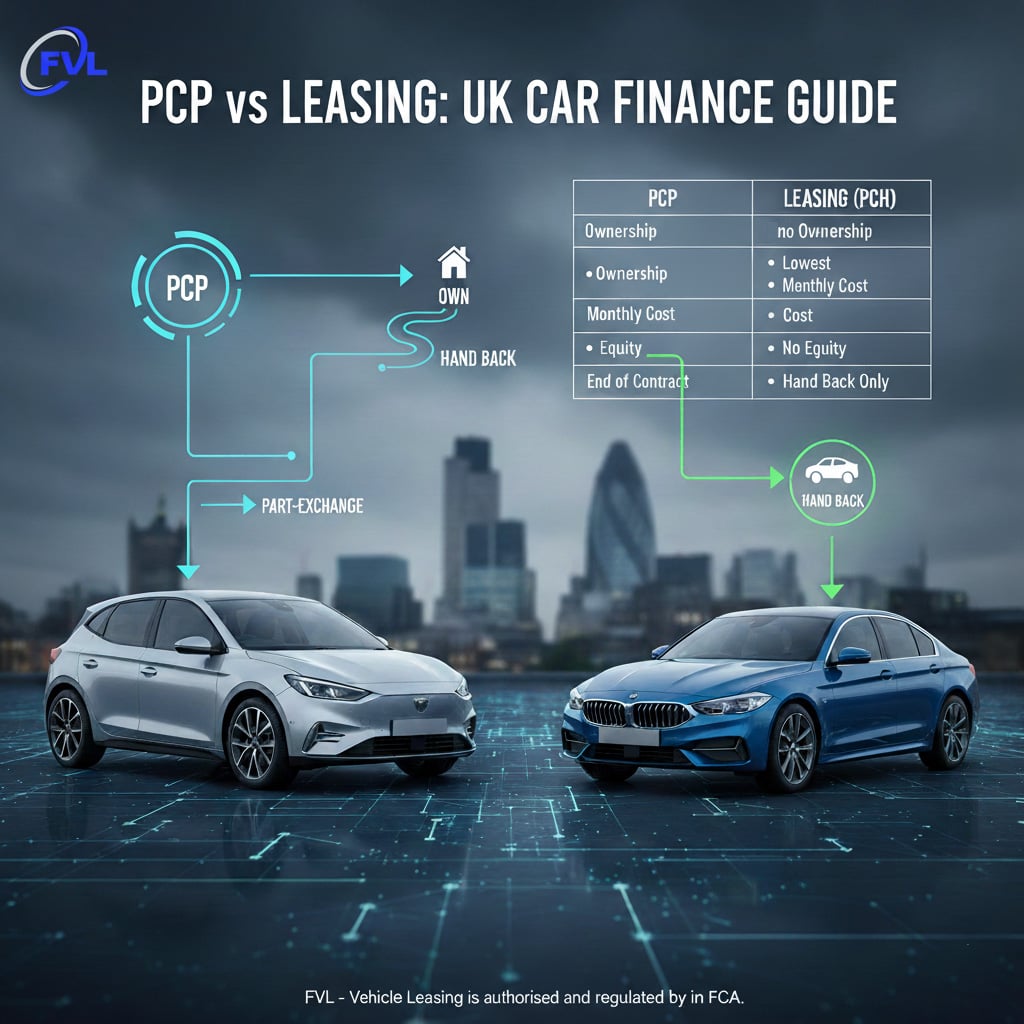

PCP and leasing look almost the same on a quote. You pay something upfront, then a fixed monthly amount, and you drive a new car for two to four years. They are different products, though, and they suit different drivers. This 2026 guide from First Vehicle Leasing puts PCP and leasing (PCH) side by side, with the current tax rules, the latest FCA changes and a simple way to decide.
Key Takeaways
- Personal Contract Purchase (PCP) is a loan with a large final balloon payment. At the end you can pay it and keep the car, part-exchange the car or hand it back.
- Personal Contract Hire (PCH) is a rental. You pay an initial rental and then fixed monthly rentals, and you hand the car back at the end. You can't buy the car.
- A lease rental covers the gap between what the car costs and what it's forecast to be worth at the end, plus interest charges. On a PCP you pay interest on everything you borrow, including the balloon.
- Voluntary termination under the Consumer Credit Act 1974 applies to PCP but not to PCH. You can use it once you've paid 50% of the total amount payable.
- Company car tax (Benefit in Kind) on a fully electric car is 4% of list price in 2026/27 and rises to 5% in 2027/28.
What Is the Difference Between PCP and Leasing (PCH)?
The main difference is ownership. PCP is a finance agreement that ends with a choice: pay the balloon and keep the car, part-exchange it or hand it back. PCH is a long-term rental with only one ending, which is returning the car. PCP gives you options. Leasing gives you certainty, and it often has a lower monthly cost.
| Feature | PCP | Leasing (PCH) |
|---|---|---|
| Agreement type | Regulated credit (a loan) | Regulated consumer hire (a rental) |
| Upfront | Deposit, which reduces the amount you borrow | Initial rental, usually 1, 3, 6 or 9 months' worth |
| Monthly | Instalments, with interest shown as an annual percentage rate (APR) | Fixed rentals with no APR |
| End of contract | Pay the Guaranteed Minimum Future Value (GMFV), part-exchange or return | Return the car |
| Equity | Possible if the car is worth more than the GMFV | None, and the end value isn't your risk |
| Early exit | Voluntary termination once 50% of the total amount payable has been paid | Early termination charge set by the funder |
| Maintenance | Usually your responsibility | Optional fixed-cost package |
How Does PCP Work in 2026?
With PCP you pay a deposit and then monthly instalments. The instalments cover the car's expected loss in value plus interest, and the interest is charged on the full amount borrowed. That includes the GMFV, which is the large final balloon payment the lender guarantees the car will be worth when the agreement ends. Your options depend on that figure.
At the end you have three routes. You can pay the balloon and own the car. You can part-exchange it, where a dealer settles the balloon and any equity goes towards your next car. Or you can return it and pay any excess mileage or damage charges. PCP is regulated credit, so the lender has to show the APR and the total amount payable before you sign. Check both figures, not just the monthly instalment.
How Does Leasing (PCH) Work?
You pay an initial rental, often three, six or nine months' worth, and then a fixed monthly rental for the rest of the term. At the end you hand the car back. The rental is based on the gap between the car's cost and its forecast end value (the residual value), plus interest charges. You never own the car.
The initial rental isn't a deposit. It's paid at the start and it isn't refunded. When the car is collected it's inspected against the BVRLA industry standard, and the BVRLA's guidance on returning a leased vehicle suggests checking the car 10 to 12 weeks before it's due back. Leasing works well for electric cars in particular. If battery values fall faster than forecast, that loss belongs to the funder, not to you. That's one reason family EVs such as the Skoda Elroq are such common lease choices.


Is It Cheaper to Lease or PCP a Car?
If you change cars every three or four years, leasing usually costs less each month. A PCP charges interest on everything you borrow, including a balloon you may never pay. A lease rental covers the gap between the car's cost and its forecast end value, plus interest charges. Buying can still come out cheaper if you plan to keep the car for many years.
Volume makes a difference too. Brokers like us commit to manufacturers for large numbers of vehicles, so the price we pay for each car is lower. The residual value, however, is set against the car's expected market value, not against what the funder paid. So a lower starting cost narrows the gap you fund without lowering the end value. The best value is usually on our special offers, where we've bought in depth. Decide on your budget and what you need from a car before you settle on a model.
How Can I Tell If a Lease Deal Is Good Value?
Divide the car's list price by the monthly rental. The result tells you how many monthly rentals fit into the price of the car, and a higher number is better. For example, a £30,000 list price with a £300 rental gives 100. As a guide, above 90 is strong value, 80 to 90 is reasonable and below 80 is poor value. The test only works if you compare like with like. The deals need the same initial rental, term and mileage (a 9+35 against another 9+35, never against a 1+35), and both figures must be on the same VAT basis.
Will I be approved?
Five questions, no sign-up, and an honest answer before you apply for anything.
Check my eligibilityDoes PCP Equity Really Exist?
It can, but you can't count on it. Equity is the amount by which your car's actual value beats the GMFV at the end of the agreement. The used car market sets that value, not the lender. So equity comes from market conditions, not from anything built into the agreement, and a PCP that shows equity one year might show none the next.
Illustrative example: a £30,000 car on PCP has a GMFV of £15,000. If it's worth £17,000 at the end, you have £2,000 of equity to put towards your next car. If it's only worth £13,000, you hand it back and the £2,000 shortfall is the lender's problem, as long as you're within your mileage and the car is in good condition. Negative equity mostly catches out people who settle or part-exchange a PCP early.
What If You Need to End the Contract Early?
On PCP, the Consumer Credit Act 1974 (sections 99 and 100) gives you the right to hand the car back once you've paid half the total amount payable. The balloon counts towards that total, so most people only reach the halfway point late in the term. On PCH there's no such right. Ending early means an early termination charge set by the funder.
Mileage works differently on each product. A lease has a fixed allowance and a pence-per-mile excess charge written into the contract. On a PCP, going over your mileage lowers the car's value, and you'll also pay a charge if you return it. In our experience, most unhappy early exits come from choosing too low a mileage to get a cheaper monthly figure. Estimate honestly. Our guide to early exit and mid-contract changes explains your options.
Which Is Better for Business Users: BCH or Business PCP?
For most VAT-registered businesses, Business Contract Hire (BCH) is the more tax-efficient choice. If the car has some private use, you can typically reclaim 50% of the VAT on the rentals and all of it on a maintenance package. Rentals are also usually deductible against profits. Business PCP makes more sense if the company wants to own the car at the end.
For cars over 50g/km CO2, 15% of the rental is disallowed for tax. The driver pays Benefit in Kind (BIK) tax on the car's list price, whether the company leases it or buys it. Under HMRC's appropriate percentage tables, fully electric cars are taxed at 4% in 2026/27, 5% in 2027/28, 7% in 2028/29 and 9% in 2029/30. Petrol and diesel cars are taxed at roughly 15–37%, depending on CO2. At those rates, an EV such as the Kia EV3 can cost far less in tax than a petrol equivalent. Employees can often get an EV even more cheaply through salary sacrifice.


What Has Changed for Car Finance and EVs in 2026?
Two changes matter this year. The FCA confirmed a compensation scheme for PCP and HP customers who took out finance between 2007 and 2024 and weren't told about commission, but legal challenges have suspended parts of it. Separately, electric cars will pay a per-mile tax from April 2028, which affects EV leases that run beyond that date.
The FCA published the scheme rules (PS26/3) in March 2026. The Upper Tribunal is due to hear the challenges in December 2026 or February 2027. None of this changes how PCP or PCH works today. Under FCA rules, brokers must still tell you how they're paid. The new electric vehicle tax, called eVED and run by the DVLA, is planned at 3p per mile for EVs. The government says it will set up special arrangements for leasing companies, and the detail is still being worked out.


PCP or Leasing: Which Should You Choose?
Choose PCP if you want the option to own the car, might keep it beyond the term or want to gamble on equity. Choose leasing if you want a new car every few years, fixed costs and no worry about what the car is worth at the end. Most private drivers who never plan to pay a balloon are better off leasing.
PCP suits you if...
You may want to own the car, you'd like the flexibility to decide at the end, or your mileage is hard to predict and you'd rather have a balloon to fall back on than fixed excess charges.
Leasing suits you if...
You change cars every two to four years, want to budget to the pound and prefer to hand the car back. A low-mileage driver in a small hybrid such as the Toyota Yaris Cross is a typical example.
Our Five-Point Checklist Before You Sign
- Will I actually want to own this car in three or four years?
- What's my honest annual mileage, with some room to spare?
- On a PCP quote, what are the APR and the total amount payable, not just the monthly instalment?
- On a lease, am I comparing deals on the same initial rental, term and mileage?
- If I'm a company car driver, have I checked the BIK rate and salary sacrifice?
Related guides
When Leasing Is NOT the Right Choice: 8 Honest ReasonsLeasing vs PCP: The Real Differences ExplainedLosing Your Job During a Lease: Your OptionsWhat If I Can't Afford My Lease Payments? Your OptionsView all guidesFrequently Asked Questions
Want to compare PCP and leasing on a specific car? Call our team on 0333 003 3325.
View DealsSources
- Returning your leased vehicle - BVRLA
- Work out the appropriate percentage for company car benefits (480: Appendix 2) - HMRC / GOV.UK
- PS26/3: Motor finance consumer redress scheme - Financial Conduct Authority
Written by Andy Bell, First Vehicle Leasing.